Is the prestige of a legacy brand name truly worth the additional investment, or are you paying for historical reputation rather than modern aluminium engineering? When specifying high-end glazing, many property owners find themselves caught in a difficult trade-off between architectural ambition and financial reality. The challenge of Smart Systems vs. Alunet: Balancing Premium Aesthetics with Project Budgets requires a technical understanding of how each system performs under pressure. You shouldn't have to compromise on the sleek, slimline look of your bifold or sliding doors just to stay within a sensible fiscal limit.
We understand the anxiety that comes with choosing between these industry heavyweights, particularly regarding the 2026 Part L thermal regulations. This article provides a definitive framework for your decision, comparing U-values, maintenance requirements, and aesthetic finishes. You'll gain the confidence to select a system that delivers premium reliability without unnecessary expenditure. We'll examine the structural integrity of both Alunet's Aluna range and the established Smart Alitherm series, ensuring your architectural vision aligns perfectly with your practical requirements.
Key Takeaways
- Understand how the 2026 Part L updates impact your choice of aluminium systems to ensure long-term thermal compliance and avoid costly future-proofing errors.
- Explore the engineering heritage of Smart Systems to determine why their Alitherm and Visofold ranges remain the industry benchmark for structural reliability in large-scale apertures.
- Evaluate the aesthetic advantages of Alunet’s ultra-slim profiles for projects where maximising natural light and achieving a luxury, 'invisible' glazing finish is the primary architectural goal.
- Master the art of Smart Systems vs. Alunet: Balancing Premium Aesthetics with Project Budgets by identifying high-impact zones where luxury profiles add value and where standard systems offer sensible savings.
- Learn why technical specification and professional surveying are more critical to project success than the choice of profile alone, protecting your investment from common installation pitfalls.
Smart Systems vs Alunet: Navigating the 2026 Aluminium Glazing Market
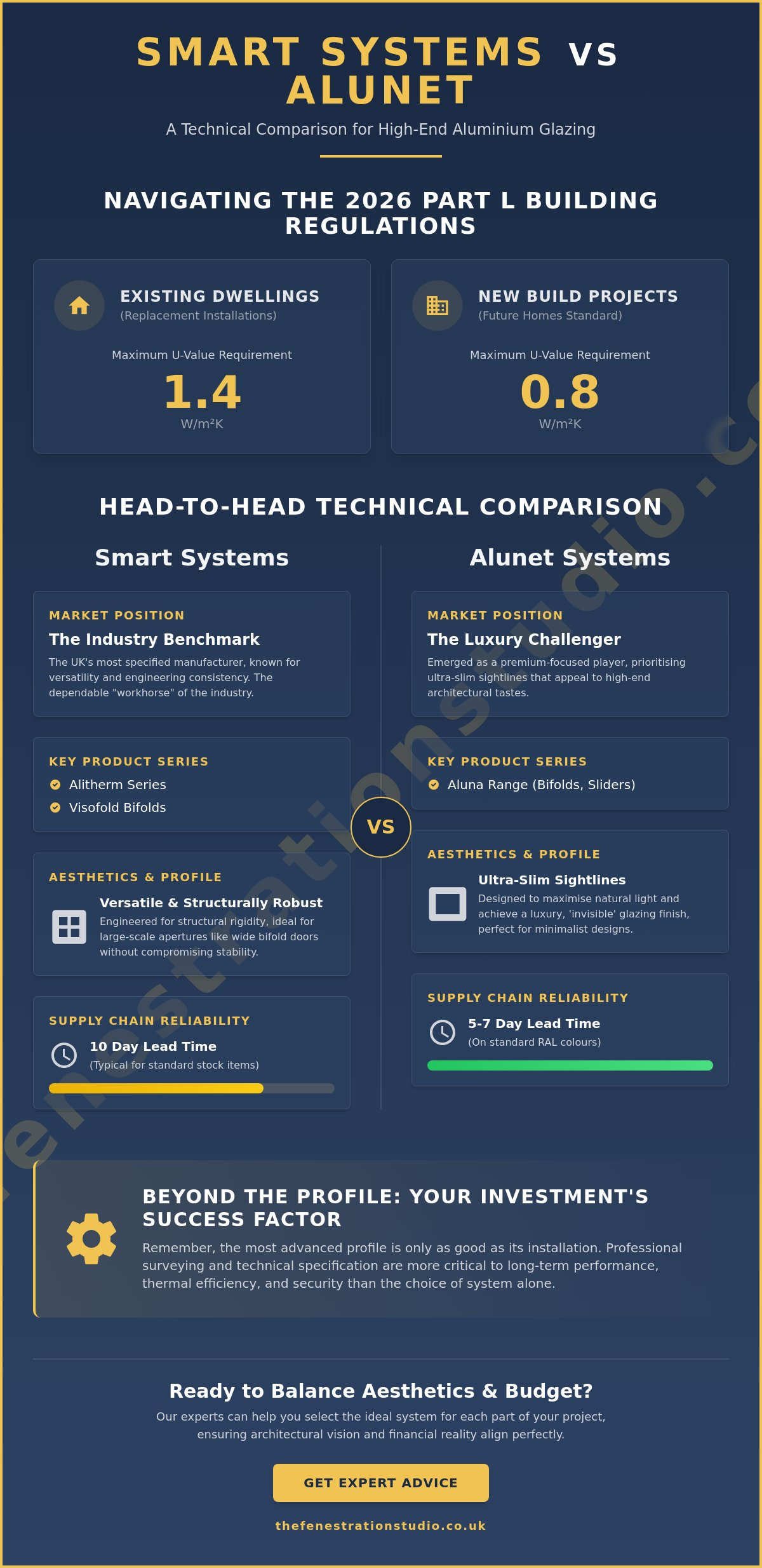
The UK glazing industry has reached a critical juncture. Following the 2026 updates to Part L Building Regulations, the technical requirements for residential windows and doors have become significantly more demanding. For replacement installations in existing dwellings, systems must now achieve a maximum U-value of 1.4 W/m²K. New build projects are under even stricter mandates, with the Future Homes Standard requiring a U-value of 0.8 W/m²K. This regulatory shift has forced a move away from basic profiles toward highly engineered architectural systems.
Choosing between the industry's two most prominent players requires a nuanced understanding of their market positions. Smart Systems remains the UK's most widely specified manufacturer, known for the sheer versatility of its Alitherm and Visofold series. It is the dependable workhorse of the industry. Conversely, Alunet Systems has emerged as a luxury-focused challenger. Since its acquisition by Eurocell plc in March 2025, Alunet has aggressively expanded its "Aluna" range, prioritising ultra-slim sightlines that appeal to high-end architectural tastes. Understanding Smart Systems vs. Alunet: Balancing Premium Aesthetics with Project Budgets is no longer just about the look; it's about technical compliance and fiscal discipline.
The Evolution of Residential Glazing Requirements
The days when aluminium was chosen solely for its "industrial look" are over. Modern homeowners demand the thermal efficiency of uPVC with the slender profiles only metal can provide. Standard aluminium profiles from a decade ago cannot meet the current 1.4 W/m²K threshold without advanced thermal breaks. The structural integrity of these systems relies on high-grade Aluminium alloys, which provide the necessary strength-to-weight ratio for slim profiles. This evolution has turned domestic renovations into complex engineering projects where the choice of system dictates the comfort and energy costs of the home for decades.
Establishing the Evaluation Framework
To make an informed choice, we evaluate these systems through three primary lenses:
- Thermal Performance: We examine the depth of the polyamide thermal breaks. This technology is what prevents heat transfer and ensures your aluminium windows meet the 2026 standards.
- Aesthetic Versatility: We compare the range of powder coating options. Whilst both offer standard RAL colours, the texture and longevity of the finish vary between the two manufacturers.
- Supply Chain Reliability: Lead times are a critical budget factor. Alunet currently offers a 5-7 working day lead time on standard colours, whilst Smart Systems typically operates on a 10-day cycle for stock items like the Alitherm 400.
The "Premium-Budget" Paradox often surprises our clients. The most expensive profile isn't always the superior choice for every aperture. A massive aluminium bifold door requires the structural rigidity of a Smart Visofold, whilst a small, decorative casement window might benefit more from the slim Aluna aesthetic. Our role is to ensure your investment is allocated where it provides the most tangible benefit.
Smart Systems: The Benchmark for Versatility and Engineering Reliability
Smart Systems has earned its reputation as the UK’s most versatile aluminium manufacturer through decades of engineering consistency. Their Alitherm and Visofold series aren't just products; they're the architectural standards against which all other systems are measured. When considering Smart Systems vs. Alunet: Balancing Premium Aesthetics with Project Budgets, Smart often represents the pragmatic choice for large-scale residential renovations. Their market dominance is built on a foundation of reliability that few challengers can match.
One of the brand's greatest strengths lies in its ability to handle oversized apertures. Whilst some boutique systems struggle with the weight of expansive glass panes, Smart profiles are engineered for structural rigidity. This engineering excellence is supported by material standards championed by organisations like The Aluminum Association, ensuring that the material properties are maximised for safety and longevity. Because Smart operates at such a high volume, they often provide superior cost-effectiveness. This economy of scale allows homeowners to achieve a high-end look without the "boutique" price tag often associated with luxury imports.
Customisation is another area where Smart excels beyond basic colour charts. Their 'Sensations' range offers unique textured finishes that provide a tactile, premium feel often absent in standard powder coating. These finishes don't just look different; they offer enhanced scratch resistance and a sophisticated matte appearance that suits both contemporary and traditional properties. This level of personalisation ensures that even a budget-conscious project can possess a bespoke architectural character.
The Smart Systems Product Hierarchy
The Alitherm series provides a balanced solution for aluminium windows, offering both traditional and contemporary frame options with advanced thermal breaks. For those seeking aluminium bifolding doors, the choice usually falls between the Visofold 1000 and the 6000. The 1000 is the industry workhorse, prized for its robust reliability and ease of use. The 6000 offers a slimmer profile for those prioritising aesthetics over absolute frame thickness. For projects requiring floor-to-ceiling glazing, the Smart Wall system allows for commercial-grade "glass walls" in a residential setting, providing unparalleled structural support.
Why Architects Favour Smart Systems
Architects specify Smart Systems because they're a known quantity. They have a proven track record of weather performance in the unpredictable British climate, ensuring long-term security and peace of mind. The availability of comprehensive CAD data allows for precise technical planning during the design phase, reducing the risk of onsite errors. If you're looking to refine your project's technical specifications, you might consider booking a design consultation to explore these options in detail. The integration with heritage styles is equally seamless; Smart offers specific profiles designed to replicate steel windows, making them ideal for sensitive renovations where modern thermal performance is required within a historical context.
Alunet Systems: Elevating Aesthetics with Luxury Architectural Profiles
Alunet Systems represents the refined edge of the contemporary glazing market. Whilst Smart Systems provides the versatile foundation for many UK builds, Alunet focuses on a specific architectural niche: the pursuit of the 'invisible' frame. Their Aluna philosophy revolves around the reduction of visible aluminium to maximise the glass-to-frame ratio. This approach is particularly effective for homeowners seeking to create a seamless transition between interior living spaces and the exterior landscape. When evaluating Smart Systems vs. Alunet: Balancing Premium Aesthetics with Project Budgets, Alunet positions itself as the specialist choice for those prioritising ultra-slim sightlines.
The technical precision required to achieve these minimalist aesthetics is significant. Adhering to the rigorous standards set by the Council for Aluminium in Building (CAB), Alunet ensures that their slim profiles don't compromise on structural integrity or thermal efficiency. This is a crucial distinction; many budget slimline systems sacrifice security or insulation to achieve a thin frame. Alunet, however, maintains the necessary rigidity to support large-scale glazing whilst meeting the 2026 Part L requirements. It's a sophisticated balance of engineering and art.
The Aluna Bifold and Sliding Door Suite
The centrepiece of the Aluna range is the bifolding door, which boasts meeting stiles of just 107mm. This is significantly narrower than many industry standards, offering a noticeably lighter visual impact when the doors are closed. For those seeking even greater transparency, Alunet’s aluminium sliding doors provide panoramic views with minimal vertical obstruction. These systems are engineered to carry substantial glass weights, allowing for larger individual panes that reduce the number of visible frames across a wide aperture. Despite these slender dimensions, the thermal performance remains uncompromising, achieving low U-values through advanced polyamide thermal break technology.
The Aesthetic Edge: Luxury Finishes and Hardware
Alunet understands that luxury is defined by the details. Their exclusive colour palettes are curated to complement modern architectural trends, moving beyond standard anthracite to offer more sophisticated, architectural tones. The user experience is further elevated by ergonomic hardware designs. The handles and locking mechanisms aren't merely functional; they're designed with a 'White Glove' tactile quality that reflects the system's premium positioning. Security is integrated seamlessly, with options for electronic locking and compatibility with modern smart home ecosystems. This focus on the sensory and technical aspects of the product makes Alunet the preferred specification for minimalist, high-end residential projects where every millimetre of frame matters.
Value Engineering: Balancing Premium Design with Project Budgets Realities
Value engineering is the discipline of maximising architectural impact whilst maintaining strict fiscal control. It is not merely a cost-cutting exercise. Instead, it is a strategic allocation of resources that ensures every pound spent contributes to the property's long-term value. When deciding between Smart Systems vs. Alunet: Balancing Premium Aesthetics with Project Budgets, the most successful projects are those that identify "High-Impact" zones where luxury profiles are essential and secondary areas where standard systems suffice.
The total cost of ownership extends far beyond the initial quote. You must factor in maintenance, durability, and energy savings. Whilst both systems meet the 2026 Part L requirements, the precision engineering of Alunet often requires a more specialised installation approach, which can influence project timelines. Conversely, the ubiquity of Smart Systems means that technical support and replacement components are readily available, potentially reducing long-term maintenance anxiety. If you are ready to see how these figures apply to your specific project, you can request a bespoke quote to begin your financial planning.
Comparative Analysis: Smart vs Alunet Head-to-Head
A direct comparison reveals distinct engineering priorities. Alunet’s Aluna bifold offers an ultra-slim 107mm meeting stile, providing a superior glass-to-frame ratio that caters to minimalist tastes. Smart Systems’ Visofold 1000, whilst slightly broader in its profile, offers a robust structural integrity that has been proven over decades in the UK market. Thermal efficiency is comparable across both brands, with both manufacturers offering advanced polyamide breaks that accommodate high-performance double or triple glazing. In terms of price positioning, Smart Systems generally offers a more accessible entry point due to its massive production volume, whilst Alunet carries a premium reflecting its specialist, slimline status.
Value Engineering Your Glazing Package
Strategic specification is the key to a balanced budget. We often advise clients to prioritise Alunet for focal points, such as rear-facing aluminium sliding doors that lead onto a terrace or garden. These are the areas where the "invisible" glazing philosophy provides the greatest emotional and aesthetic return. For side elevations, utility rooms, or secondary bedroom aluminium windows, Smart Systems' Alitherm range provides a perfectly cohesive look at a more conservative price point.
The choice of glass also plays a pivotal role. Upgrading to triple glazing on a Smart System can sometimes provide better thermal performance for the same total cost as a double-glazed Alunet system. This allows you to choose between prioritising ultra-slim aesthetics or maximum energy efficiency based on your project's specific goals. By mixing and matching these systems within a single property, you can achieve a high-end architectural finish without exceeding your financial parameters.
Beyond the Profile: Why Professional Installation Defines Your Project's Success
Selecting a premium glazing system is only the first stage of a successful architectural project. The engineering integrity of your windows and doors relies entirely on the precision of the final fit. Even the most advanced thermal breaks or the slimmest sightlines are compromised if the aperture isn't surveyed with millimetre precision. Our "White Glove" philosophy treats the installation as a specialised engineering service rather than a manual task. This ensures that the chosen solution for Smart Systems vs. Alunet: Balancing Premium Aesthetics with Project Budgets performs exactly as the manufacturer intended.
We operate with a dual identity that balances a strong regional presence with high-level industry standards. This approach allows us to provide nationwide expertise whilst maintaining the personalised care of a local consultant. Professional surveying is the pivot point of this process. It's during this technical phase that we account for structural tolerances, drainage requirements, and the specific thermal demands of the 2026 Building Regulations. Without this level of technical rigour, even the highest-quality aluminium profiles can suffer from air leakage or operational friction.
The Fenestration Studio Installation Standards
Our process begins with an authoritative, consultative review of your architectural plans. We don't simply supply products; we guide you through the technical nuances of each system. By offering honest, project-specific advice, we help you decide whether the structural robustness of Smart Systems or the minimalist elegance of Alunet is the correct fit for your home's specific elevations. To see how these systems integrate into various architectural styles, you can explore our full range of aluminium products.
Following the initial consultation, our technical surveyors conduct a comprehensive onsite assessment. This stage is critical for bespoke glazing, where the interaction between the aluminium frame and the building fabric must be flawless. We manage the entire project lifecycle, ensuring a stress-free experience that prioritises long-term security and reliability over a quick, low-cost fitting.
Ensuring Long-Term Performance
Precision is not a luxury. It's a requirement for modern thermal and acoustic integrity. Whilst Alunet’s slimline profiles offer an exquisite aesthetic, they demand a level of fitting expertise that less experienced installers may struggle to provide. Our teams are specifically trained to handle the unique requirements of both Alunet and Smart Systems, from the heavy-duty rollers of a sliding door to the delicate alignment of a heritage-style casement window.
Dedicated aftercare closes the loop on your investment. A premium aluminium system should operate as smoothly in its tenth year as it did on day one. We provide the technical documentation and maintenance guidance necessary to protect your warranty and ensure the system continues to meet the 1.4 W/m²K thermal threshold. If you're ready to move from planning to execution, book a design consultation to see these systems in person and discuss your project's specific parameters.
Securing Your Architectural Vision with Technical Precision
Achieving the perfect equilibrium between high-end design and fiscal responsibility requires more than just selecting a profile from a brochure. The decision between Smart Systems and Alunet is a strategic choice that dictates the long-term thermal efficiency and structural integrity of your property. Whilst Alunet offers an ultra-slim, luxury aesthetic for minimalist focal points, Smart Systems provides a robust and versatile foundation for expansive apertures. Both manufacturers remain fully compliant with the 2026 Part L regulations, ensuring your home is future-proofed against demanding energy standards.
Success in Smart Systems vs. Alunet: Balancing Premium Aesthetics with Project Budgets ultimately rests on the quality of the technical survey and the precision of the installation. Our approach removes the uncertainty from this complex process by providing expert technical surveys, nationwide installation teams, and unbiased advice on the UK's leading aluminium brands. Request a technical quote for your project today to ensure your glazing package is engineered for excellence. We look forward to guiding you through a seamless, stress-free journey toward your ideal home environment.
Frequently Asked Questions
Is Alunet significantly more expensive than Smart Systems?
Alunet is positioned as a luxury specialist, so it generally commands a premium over Smart Systems' volume-produced ranges. Whilst Smart Systems benefits from massive economies of scale, Alunet’s focus on ultra-slim profiles and niche aesthetics involves higher manufacturing costs. The price difference often reflects the specialist engineering required for the Aluna range’s minimalist frames. This investment is typically justified in areas where the visual impact is the primary project goal.
Which system offers better thermal efficiency for 2026 building regulations?
Both systems are engineered to exceed the 2026 Part L requirements of 1.4 W/m²K for replacement glazing. Smart Systems achieves this through its established Alitherm range, whilst Alunet utilises advanced thermal breaks in its Aluna+ Window System. The final U-value depends heavily on your choice of glass, but both manufacturers provide the technical framework necessary for full compliance. Choosing between them often comes down to aesthetic preference rather than thermal limitations.
Can I mix Smart windows with Alunet doors in the same project?
Mixing systems is a common and effective strategy for Smart Systems vs. Alunet: Balancing Premium Aesthetics with Project Budgets. We often specify Alunet for focal points like rear sliding doors whilst using Smart Alitherm windows for side elevations. This approach allows you to prioritise investment where it has the most visual impact whilst maintaining a consistent architectural feel across the property. It ensures fiscal discipline without compromising the home's overall design integrity.
What are the thinnest sightlines available between Smart and Alunet?
Alunet currently offers the thinnest sightlines with its Aluna bifold, featuring a meeting stile of just 107mm. In comparison, the Smart Visofold 1000 is broader, though the Visofold 6000 offers a slimmer alternative. Alunet’s design philosophy specifically prioritises the "invisible" frame, making it the superior choice for projects where minimising visible aluminium is the primary objective. These slender profiles allow for larger glass areas and more natural light.
Do both systems come with a marine-grade finish for coastal properties?
Both manufacturers offer marine-grade powder coating options to protect against salt-induced corrosion. This specialist finish is essential for properties within three miles of the coast to ensure long-term durability. We recommend specifying a minimum of 60 microns for these environments to prevent surface degradation. Both Smart and Alunet provide extensive colour palettes in these resilient, architectural-grade finishes, ensuring your project remains protected regardless of its proximity to the sea.
How long are the typical lead times for these aluminium systems in the UK?
Lead times vary by product and colour choice. As of May 2026, Alunet typically offers a 5-7 working day lead time on standard colours like black, white, and grey. Smart Systems generally operates on a 10-day lead time for stock items like the Alitherm 400. However, bespoke colours or complex bifold configurations can extend these timelines to 15-20 working days. Planning your order early is essential to maintaining your project's schedule.
Which system is more secure against modern burglary methods?
Security is a core component of both systems; both meet PAS 24 standards and are "Secured by Design" accredited. They utilise multi-point locking mechanisms and high-security cylinders to resist forced entry. Whether you choose the robust Smart Visofold or the slimline Aluna range, you're investing in a system that has been rigorously tested against modern burglary techniques. Professional installation remains the most critical factor in ensuring these security features perform as intended.
Do Smart Systems or Alunet offer better heritage-style options?
Smart Systems is widely regarded as the leader for heritage projects due to its specific Alitherm Heritage range. These profiles are designed to replicate the slim sightlines of traditional steel windows, making them ideal for sensitive renovations. Whilst Alunet offers a modern, minimalist aesthetic, Smart provides the historical accuracy required for listed buildings or conservation areas. This makes Smart the preferred choice when maintaining the historical character of a property is a regulatory requirement.