
A standard paint finish on a coastal property is not a calculated risk; it is a guaranteed failure of your home’s architectural integrity. You likely invested in your shoreline location for the expansive views, yet you probably didn't expect to see white pitting on your aluminium frames or feel salt grit seizing your sliding door mechanisms after only two seasons. Understanding Glazing for Coastal Exposure: Why Marine-Grade Finishes are Non-Negotiable is the first step in avoiding these expensive pitfalls and ensuring your fenestration survives the elements.
We believe that high-end glazing should offer peace of mind, not a mounting maintenance list. You'll discover how the AAMA 2605 superior performance standard, which requires 4,000 hours of salt spray testing, provides the necessary protection for your architectural investment. This guide provides a clear look at the latest May 2026 data on lifecycle costs and explains how marine-grade specifications preserve the premium aesthetic and resale value of your coastal home.
Key Takeaways
- Identify the hidden mechanics of filiform corrosion and why salt-laden air necessitates a specialised approach to protect your aluminium frames.
- Discover the technical benchmarks of Glazing for Coastal Exposure: Why Marine-Grade Finishes are Non-Negotiable, focusing on the Qualicoat Seaside standard and intensive pre-treatment protocols.
- Evaluate the architectural investment by comparing the initial premium against the long-term lifecycle savings of avoiding premature frame failure and replacement.
- Gain a practical checklist of non-negotiable specifications, from acid-etched coatings to self-cleaning glass, required for high-performance coastal fenestration.
- Understand how a professional micro-climate survey ensures your bespoke installation is engineered to withstand the specific environmental pressures of your site.
The Coastal Challenge: Salt, Wind, and the Science of Corrosion
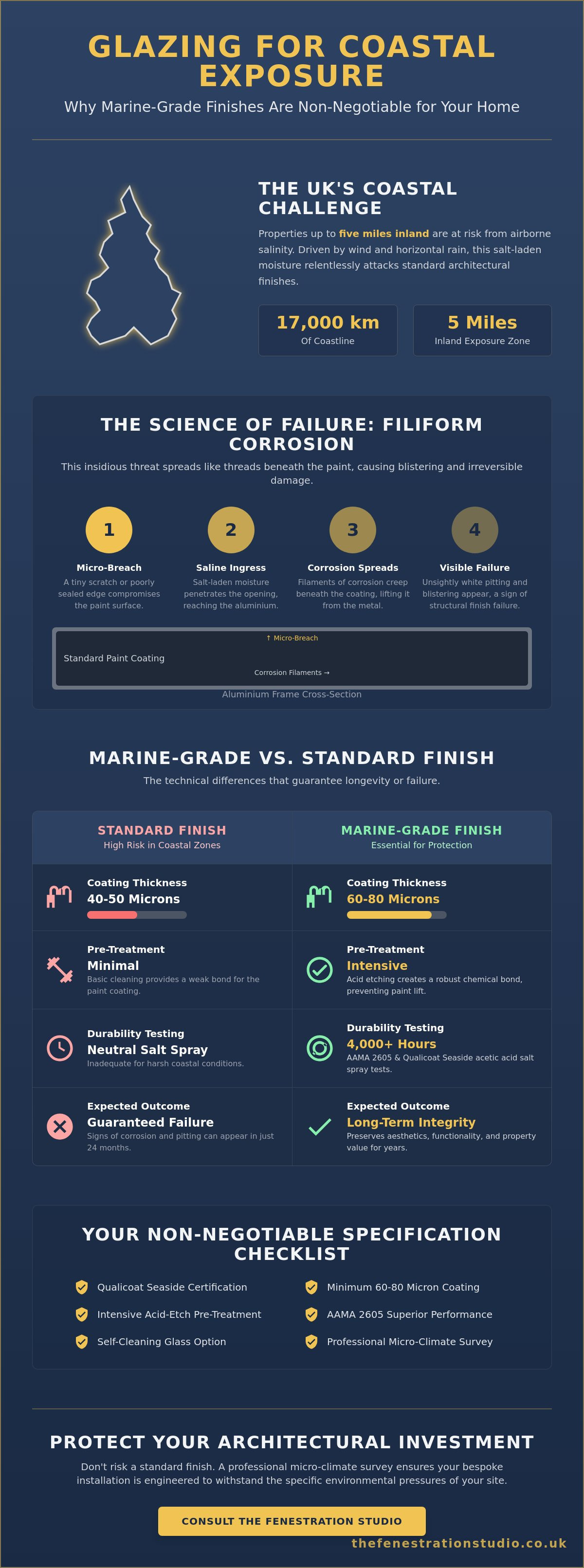
A coastal postcode is a luxury, but for architectural finishes, it's a relentless battleground. Whilst the UK’s 17,000km coastline provides breathtaking views, it also serves as a high-octane laboratory for material degradation. Many homeowners assume that "coastal" only applies to properties with a beach at the end of the garden. In reality, industry standards define the coastal zone as extending up to five miles inland. This airborne salinity doesn't just settle on surfaces; it's driven deep into your home's framework by horizontal rain and prevailing south-westerly winds. This environmental pressure is precisely why Glazing for Coastal Exposure: Why Marine-Grade Finishes are Non-Negotiable is a vital consideration for any renovation or new build.
The most insidious threat to your investment is filiform corrosion. This specific type of attack occurs when salt-laden moisture penetrates the paint's surface through a microscopic scratch or a poorly sealed edge. Once underneath, the corrosion spreads in thread-like filaments, lifting the coating and creating unsightly white pitting. Unlike surface grime, this is a structural failure of the finish. To ensure longevity, high-specification finishes must undergo a rigorous salt spray test to measure their resistance to this saline-induced decay. Without a marine-grade specification, even the most beautiful aluminium windows can show signs of failure within just 24 months.
The Chemistry of Saline Loading
Salt is relentless. Salt crystals are hygroscopic agents, which means they actively attract and hold moisture from the air against the metal surface. This creates a permanent "wet" state on your frames, even during dry spells. In the UK, our heavy south-westerly winds accelerate this process, forcing salt grit into moving parts like aluminium sliding doors. This isn't a "set and forget" environment. Standard aluminium lacks the dense pre-treatment layers required to resist this constant chemical attack, leading to seized mechanisms and a compromised aesthetic.
Beyond the Shoreline: Identifying Your Exposure Zone
We categorise environments into 'Marine' and 'Severe Marine' based on more than just distance. A property three miles inland on an elevated cliff-top might face higher exposure than a sheltered house 500 yards from the shore. Prevailing winds act as a conveyor belt for salt deposition; if your home sits in the path of direct sea gales, your specification needs to be uncompromising. Even sheltered coastal properties require enhanced protection because salt spray lingers in the air as a fine mist, settling in recesses where it can't be easily washed away by rain. Identifying these micro-climates is a core part of our consultative process.
What Defines a Marine-Grade Finish? The Technical Standard
Specifying the correct finish for a shoreline property requires moving beyond aesthetic choices to focus on precise engineering. A standard powder coating might look identical to a marine-grade one on the day of installation, but the technical composition is worlds apart. When we discuss Glazing for Coastal Exposure: Why Marine-Grade Finishes are Non-Negotiable, we're referring to a specific set of manufacturing protocols designed to prevent chemical failures. This involves a combination of enhanced paint thickness, specialised chemical pre-treatments, and the industry-leading Qualicoat Seaside certification.
For a finish to be truly marine-grade, the powder coating must reach a minimum thickness of 60 to 80 microns. Standard residential coatings often fall between 40 and 50 microns, which provides insufficient protection against the abrasive nature of salt grit. However, thickness alone isn't enough. The aluminium must undergo an intensive acid etching process to remove surface impurities, followed by a chrome-free conversion coating. This ensures the paint doesn't just sit on top of the metal but creates a robust chemical bond that resists lifting.
Qualicoat Seaside vs. Standard Powder Coating
Qualicoat Seaside is the industry-leading certification for architectural aluminium. To achieve this mark, the coating must pass a specialised acetic acid salt spray test. This is significantly more aggressive than the neutral salt spray tests used for standard products; it mimics the acidic, corrosive nature of a coastal micro-climate. Without this certification, standard coatings are prone to "bubbling" as salt finds microscopic pathways beneath the surface. This creates a pressure point that eventually causes the paint to peel away in large flakes, leaving the structural aluminium exposed to the elements. Choosing a certified finish is the only way to ensure your aluminium windows maintain their integrity over decades rather than years.
The Role of Pre-Anodisation
In "Severe Marine" environments, such as properties located within 500 metres of the high-tide mark, we often recommend pre-anodisation as the ultimate defence layer. This process creates a dense, transparent oxide layer that is chemically bonded to the aluminium before the powder coating is applied. Think of it as a secondary suit of armour. This layer is particularly vital for high-traffic areas and aluminium sliding doors, where the tracks are constantly exposed to salt and friction. Whilst a standard finish might have a lifespan of 10 years in a coastal zone, a pre-anodised frame can easily double that longevity with minimal maintenance. If you're planning a project in a high-exposure area, you might find it helpful to explore our aluminium products to see how these technical standards are applied in practice.
Marine-Grade vs. Standard Glazing: The Cost of a Compromise
Choosing a standard aluminium specification for a coastal project is often a decision based on short-term budget rather than long-term value. Whilst the initial saving might appear attractive, the reality of Glazing for Coastal Exposure: Why Marine-Grade Finishes are Non-Negotiable becomes clear when the salt spray begins its work. Standard finishes are rarely warrantied within five miles of the coast. This leaves homeowners entirely unprotected when the inevitable pitting and chalking occur. In the UK, where south-westerly gales are frequent, a standard coating is a liability, not an asset.
The financial argument for marine-grade specifications is rooted in lifecycle costs. Research from May 2026 indicates that whilst superior performance coatings like AAMA 2605 can carry an initial cost 40% to 70% higher than standard alternatives, they prevent the catastrophic expense of a total replacement. When frames fail in a coastal environment, the cost isn't just the aluminium. You must also account for scaffolding, the disruption of internal making-good, and the potential for structural water ingress. For those installing aluminium sliding doors, choosing a standard finish is an expensive mistake that often results in seized mechanisms and degraded seals within five years.
Performance Comparison Table
The following data outlines why the "coastal premium" is a necessary safeguard for your architectural investment. It compares the three primary levels of finish available for modern fenestration.
| Finish Type | Typical Lifespan (Coastal) | Maintenance Frequency | Warranty Suitability |
|---|---|---|---|
| Standard (40-50μ) | 2-5 Years | Weekly | Not Recommended |
| Marine-Grade (60-80μ) | 15-20 Years | Quarterly | Standard Coastal |
| Pre-anodised | 25+ Years | Bi-annually | Severe Marine |
The Maintenance Reality Check
Maintenance isn't just about aesthetics; it's about mechanical survival. Standard glazing in coastal zones requires weekly washing with fresh water to prevent salt crystals from bonding to the surface. Most homeowners find this schedule impossible to manage. Over time, salt buildup doesn't just ruin the look; it degrades the thermal performance of door seals and seizes internal hardware. Marine-grade finishes allow for a more manageable quarterly cleaning cycle, protecting your time and your property's resale value. Discerning buyers and surveyors now look for specific marine-grade certifications as proof of a sound architectural investment.
Specifying for Exposure: A Homeowner’s Technical Checklist
Specifying for a shoreline project requires a granular attention to detail that extends far beyond the powder coating. Whilst the finish provides the primary barrier, the internal components and glass technology must be equally robust to prevent premature failure. Understanding Glazing for Coastal Exposure: Why Marine-Grade Finishes are Non-Negotiable means looking at the entire fenestration assembly as a single, protective system. If one element is under-specified, the salt-laden air will find the weakness. Your technical specification should be an uncompromising document that leaves no room for budget substitutions.
A critical inclusion for coastal glazing is self-cleaning or "easy-clean" glass coatings. In marine environments, salt spray dries on the glass, creating a stubborn, opaque crust that can be abrasive if wiped away dry. Hydrophilic coatings use UV light to break down organic dirt and allow rainwater to wash away salt deposits more effectively. This reduces the mechanical cleaning required, protecting the glass surface from scratches and ensuring your views remain clear without weekly maintenance. This technology is particularly essential for large-scale aluminium windows where manual cleaning is difficult.
Hardware: The Silent Victim of Salt
Handles, hinges, and rollers are often the first components to fail in coastal homes. Standard hardware is typically manufactured from 304-grade stainless steel (A2), which is suitable for inland use but lacks the molybdenum required to resist chloride-induced pitting. For coastal exposure, you must insist on 316-grade marine stainless steel (A4). This material is specifically engineered for high-salinity environments. We also recommend specifying concealed hardware where possible. By tucking hinges and locking points inside the frame profile, you minimise direct exposure to the corrosive mist, significantly extending the operational life of the mechanisms.
Seals, Gaskets, and Drainage
Standard PVC gaskets often become brittle when exposed to the high UV levels and ozone found at the coast. We specify EPDM (Ethylene Propylene Diene Monomer) gaskets because they maintain their elasticity and sealing properties under extreme environmental stress. This is vital for preventing horizontal rain from bypassing the frame and compromising your thermal break. Your drainage system must also be "hidden" or baffled. Traditional face-drained systems often allow salt crystals to clog the outlets, leading to water backup and internal damage. Ensuring professional surveys account for wind-load and structural deflection is the final, essential step in your checklist. To ensure your project meets these rigorous standards, you can request a bespoke quote from our technical team today.
The Fenestration Studio Approach: Protecting Your Investment
At The Fenestration Studio, we don't view marine-grade specifications as an optional upgrade or a luxury add-on. For properties near the shoreline, they are a fundamental requirement of sound architectural engineering. Our consultative approach is designed to remove the guesswork from your project, ensuring that every Glazing for Coastal Exposure: Why Marine-Grade Finishes are Non-Negotiable remains a central pillar of your technical specification. We act as your expert mentor, guiding you through the complex technical landscape to prevent the expensive mistakes that often plague coastal renovations.
Our process begins with a detailed micro-climate survey. Proximity to the high-tide mark is only one factor; we also evaluate your property's orientation, prevailing wind patterns, and elevation. A home situated on a South-facing cliff-top requires a different level of protection than a property nestled in a sheltered harbour. By identifying these specific environmental stressors early, we ensure that every aluminium window and door is manufactured to your exact site requirements, rather than a generic industry average.
Consultative Specification for Coastal Projects
Local Expertise. National Standards. This is more than a tagline; it's our framework for quality. We help homeowners decode the technical jargon of Qualicoat Seaside and BS standards, translating complex engineering data into clear, actionable advice. Our goal is to match your finish to the specific exposure level of your home, ensuring you don't under-specify and risk failure, nor over-specify where it isn't required. This transparent, honest guidance is what differentiates us from the high-pressure tactics found elsewhere in the industry. We believe a well-informed client is our best partner.
The Installation Factor: Preserving the Finish
Even the highest-specification marine finish can be compromised by poor handling. If a frame is scratched or a protective coating is breached during fitting, you create an immediate entry point for filiform corrosion. Our "White Glove Service" ensures that your investment is handled with professional rigor from the factory floor to the final seal. Our installers are trained to manage the complexities of coastal fenestration, ensuring that hardware is correctly lubricated and drainage paths are clear. Following the installation, we provide a dedicated aftercare guide tailored to your specific location, helping you maintain the low-maintenance benefits of your new glazing for decades to come. If you're ready to secure your property's future, you can request a bespoke quote for your coastal project today.
Securing Your Shoreline Architectural Investment
Your coastal home deserves a fenestration strategy that matches the ambition of its architecture. We've explored the hidden mechanics of filiform corrosion and the reasons standard aluminium finishes fail under the chemical pressures of a saline environment. By insisting on Qualicoat Seaside accredited finishes and A4 marine-grade stainless steel hardware as standard, you aren't just buying frames; you're protecting the structural and aesthetic integrity of your property.
Understanding Glazing for Coastal Exposure: Why Marine-Grade Finishes are Non-Negotiable is the difference between a project that ages gracefully and one that requires a total replacement within a decade. Our expert White Glove Installation nationwide ensures these technical standards are preserved from the factory to the final fit. Don't leave your architectural investment to chance in the face of the UK’s relentless south-westerly gales.
Book your expert design consultation for coastal-ready glazing to begin your journey with a partner who values precision as much as you do. We look forward to helping you build a home that stands the test of time.
Frequently Asked Questions
What exactly is a marine-grade finish for aluminium windows?
A marine-grade finish is a specialised powder coating process that includes intensive chemical pre-treatment and a minimum paint thickness of 60 to 80 microns. This specification ensures the aluminium framework is protected against the aggressive, salt-laden air found in coastal zones. It often carries the Qualicoat Seaside certification, which requires rigorous acetic acid salt spray testing to guarantee resistance to filiform corrosion.
How far inland does a property need to be to require marine-grade glazing?
Industry standards generally define the coastal exposure zone as extending up to five miles inland from the high-tide mark. However, this distance isn't a rigid limit. Elevated properties or those in the path of direct prevailing winds may experience significant salt deposition much further from the shore. A professional site survey is essential to identify these specific micro-climates and determine the necessary specification.
Is there a difference between marine-grade and standard powder coating?
The primary differences lie in the chemical pre-treatment and the thickness of the applied coating. Standard powder coatings are typically 40 to 50 microns thick and lack the intensive acid etching required for marine environments. Marine-grade finishes are thicker and utilise a more robust bonding process. This is why Glazing for Coastal Exposure: Why Marine-Grade Finishes are Non-Negotiable for any shoreline architectural project.
Do marine-grade windows require any maintenance at all?
Marine-grade windows still require regular maintenance, though the frequency is significantly lower than that of standard finishes. You should clean the frames with fresh water and a mild detergent every three to six months to remove salt crystals. This prevents the buildup of corrosive deposits that could eventually undermine even the most robust protective layers over several decades of exposure.
Can I upgrade my existing aluminium windows to a marine-grade finish?
It is generally not possible to upgrade a standard finish to a marine-grade one once the windows are installed. The marine-grade specification is a factory-controlled process involving chemical baths and high-temperature curing that can't be replicated on-site. If your existing frames are showing signs of pitting or peeling, a full replacement with correctly specified fenestration is usually the only viable long-term solution.
Why is stainless steel hardware so important for coastal doors?
Standard hardware often utilises 304-grade steel, which will quickly develop "tea staining" or surface pitting when exposed to salt spray. Marine-grade hardware must be manufactured from 316-grade (A4) stainless steel, which contains molybdenum for enhanced corrosion resistance. This is vital for moving parts like rollers and hinges, ensuring they don't seize up under the pressure of coastal weather.
What happens if I don't use marine-grade finishes on my seaside home?
Failing to use a marine-grade finish will likely lead to aesthetic and structural failure within two to five years. You will notice white, thread-like pitting beneath the paint surface, known as filiform corrosion, followed by widespread peeling. This isn't just a cosmetic issue; it can lead to seized mechanisms, failed seals, and a significant reduction in your property's resale value and architectural integrity.
Does marine-grade glazing come with a longer warranty?
Marine-grade specifications are often the only way to secure a valid performance warranty for coastal properties. Most manufacturers entirely exclude standard finishes from their guarantee if the property is within a certain distance of the sea. By choosing Glazing for Coastal Exposure: Why Marine-Grade Finishes are Non-Negotiable, you gain access to long-term warranties that protect your architectural investment against environmental degradation.