What if the most expensive glazing you buy actually makes your home feel smaller and less comfortable? It's a common worry for those debating an aluminium roof lantern vs flat rooflight, as the fear of a clunky, dated frame or an uncontrollable greenhouse effect often stalls high-end projects. You likely want a solution that offers a seamless, modern aesthetic whilst maintaining strict thermal control. Choosing the wrong profile doesn't just impact the look; it can lead to structural complications and poor energy performance that fails to meet the 2026 Building Regulations.
This guide provides the technical clarity and architectural insight required for a premium installation. You'll learn why the current 2.2 W/m²K U-value standard for rooflights is just the baseline, and how triple-glazed lanterns can achieve performance levels as low as 0.7 W/m²K for ultimate year-round comfort. We will compare the internal volume created by lanterns against the flush, minimalist finish of flat rooflights to help you select the perfect specification. At The Fenestration Studio, our White Glove approach ensures every technical detail is handled with professional rigour, providing a stress-free path to a light-filled, sophisticated home.
Key Takeaways
- Identify the fundamental architectural differences between an aluminium roof lantern vs flat rooflight to determine whether you require dramatic internal volume or a sleek, flush-glazed aesthetic.
- Navigate the complexities of the 2026 Building Regulations, ensuring your installation meets the mandatory U-value standards and manages solar gain effectively.
- Assess how ceiling height and room orientation dictate your choice, ensuring your glazing provides optimal light dispersal without compromising thermal comfort.
- Understand why professional structural calculations for wind and snow loads are essential to prevent expensive long-term maintenance issues or structural failures.
- Learn how a consultative, White Glove approach ensures your bespoke project is managed with architectural precision from the initial technical survey to the final handover.
Understanding the Distinction: Aluminium Roof Lanterns vs Flat Rooflights
Choosing between an aluminium roof lantern vs flat rooflight is more than a technical specification; it's a decision that defines the architectural character of your home. A roof lantern is a multi-pane, pitched structure that rises above the roofline, creating a traditional "lantern" effect. Conversely, a flat rooflight is a minimalist, flush-glazed unit designed to sit almost invisibly within the roof plane. Both options rely on high-performance aluminium frameworks to provide the structural strength needed for slim sightlines, ensuring the glass remains the primary focus of the installation.
The Architectural History of Roof Lanterns reveals their evolution from essential light sources in classical masonry buildings to the sophisticated, thermally efficient features we install today. In 2026, the use of premium aluminium is non-negotiable for discerning homeowners. Unlike older, bulkier materials, slimline aluminium profiles allow for maximum glazing areas. This reduces the "clunky" look homeowners often fear and ensures compliance with the latest Approved Document L thermal standards. Our bespoke aluminium products are engineered to withstand the British climate whilst maintaining a consistent, high-end finish that won't degrade or warp over time.
The Architectural Appeal of the Roof Lantern
A roof lantern does more than let in light; it creates a "light-well" that significantly increases the perceived volume of a room. These structures are frequently centred over kitchen islands or dining tables to act as a dramatic focal point. Because the pitched design distributes weight more efficiently, it's possible to achieve larger glass spans without the need for heavy internal supports. Triple-glazed aluminium roof lanterns can achieve a whole-unit U-value of 0.7 to 0.9 W/m²K, which represents a 30% improvement in thermal efficiency over standard double-glazed units. It's a choice that favours architectural drama and heritage-inspired elegance.
The Minimalist Elegance of the Flat Rooflight
For properties where "less is more" is the guiding principle, flat rooflights offer an unobstructed "sky view." These units provide a frameless internal finish that integrates seamlessly with contemporary ceilings. As of early 2026, building regulations require new rooflights to meet a maximum U-value of 2.2 W/m²K, but a high-specification flat rooflight often performs much better. They are particularly effective in areas where a pitched structure might obstruct the view from first-floor windows or fall foul of strict height limits. By sitting flush with the roofline, they maintain a low-profile aesthetic that complements modern extensions without competing with the existing building's lines.
Structural Integrity and Thermal Behaviour: The Engineering Perspective
Designing for the British climate requires more than an eye for detail; it demands rigorous engineering to account for variable wind pressures and significant snow loads. When weighing up an aluminium roof lantern vs flat rooflight, the structural calculations are non-negotiable. A bespoke lantern, with its pitched rafters, naturally sheds water and distributes weight effectively, whereas a flat rooflight must be engineered to prevent water "pooling" and withstand the pressure of settled snow. Our technical surveys ensure that every framework is specified to handle these loads without compromising the slimline aesthetic homeowners desire.
Thermal performance is the cornerstone of modern fenestration. Under the 2026 edition of UK building regulations for rooflights, new installations must achieve a maximum U-value of 2.2 W/m²K. However, the upstand or kerb must meet a much stricter standard of 0.35 W/m²K to prevent thermal bridging. This is where aluminium framework depth becomes critical. A deeper, multi-chambered profile allows for a high-performance thermal break, a polyamide strip that separates the internal and external aluminium sections. This technology is vital for preventing condensation and heat loss during the winter months, ensuring your new living space remains habitable regardless of the external temperature.
Glazing Specifications: Beyond Single Pane
Premium roof glazing starts with toughened safety glass as a standard baseline. For south-facing extensions, solar control glass is essential to manage the g-value and prevent the "greenhouse effect" mentioned in Approved Document O. This specialised coating reflects up to 78% of solar heat whilst allowing natural light to flood the room. For hard-to-reach lanterns, self-cleaning coatings are a favourite amongst our clients. These coatings use UV rays to break down organic dirt, which is then washed away by rainwater, maintaining the clarity of your view without constant manual maintenance.
Aluminium vs uPVC: The Longevity Argument
While uPVC is often the cheapest option, it lacks the structural integrity required for large spans. Aluminium is significantly more stable; it doesn't warp, twist, or expand excessively in direct sunlight. This stability allows for the incredibly thin sightlines that define modern architecture. Choosing aluminium also ensures colour consistency across your property, allowing you to match your roof glazing perfectly to your existing aluminium windows. Our powder-coated finishes are designed to be a "fit and forget" solution, requiring only an occasional wipe to maintain their professional appearance for decades. If you are unsure about the best engineering approach for your extension, you can book a design consultation with one of our technical advisors.
Key Architectural Differences: Light, Aesthetics, and Planning Rules
The visual impact of an aluminium roof lantern vs flat rooflight extends far beyond their physical footprint. Light behaves differently within these two structures. A pitched lantern, with its multiple glass facets, acts as a light-catcher; it captures the sun's path from various angles throughout the day. This creates a soft, diffused glow that fills the room even as the sun moves. In contrast, a flat rooflight serves as a direct channel for vertical light. It provides a crisp, high-intensity "pool" of illumination directly beneath the unit, making it a functional choice for task-oriented areas like home offices or reading corners.
Internal aesthetics often dictate the final specification. A roof lantern creates a "feature ceiling," adding a sense of grandeur and architectural intent to an extension. It draws the eye upward, making a standard 2.4-metre ceiling feel significantly more spacious. Conversely, the flat rooflight offers a minimalist "sky view." When installed with a frameless internal finish, the transition from plaster to glass is almost invisible. This subtle approach is ideal for contemporary properties where the goal is to maintain clean, uninterrupted lines whilst inviting the outdoors in. Externally, the choice is equally defining. A lantern changes the silhouette of your home, whereas a flat rooflight maintains a low-profile aesthetic that is often preferred for more discreet architectural interventions.
Planning Permission and Building Regulations
Navigating the legal framework is a critical step in any bespoke glazing project. Under current Permitted Development rights, a rooflight on a flat roof must not project more than 150mm from the existing roof plane. For roof lanterns, height is the primary factor; they must generally remain under 4 metres to avoid a full planning application, though conservation areas and listed buildings carry much stricter limits. Compliance with Building Regulations Part L is mandatory for all new installations. Our technical surveys ensure that your existing roof joists can support the weight of the new framework, preventing structural issues that often arise from "supply-only" retail mistakes.
Ventilation and Airflow Options
Integrating ventilation into your glazing choice can significantly improve the internal climate of a glass room. We offer both manual and electric opening vents, which are particularly beneficial in kitchens to allow heat and steam to escape. Modern electric systems are now considered the standard for any installation with a ceiling height above 2.4 metres. These can be specified with rain sensors that automatically close the vent at the first sign of the unpredictable British weather. This level of automation ensures your home remains secure and dry, even if you are away from the property when a sudden downpour begins. If you are ready to discuss your specific requirements, you can request a quote from our expert team.
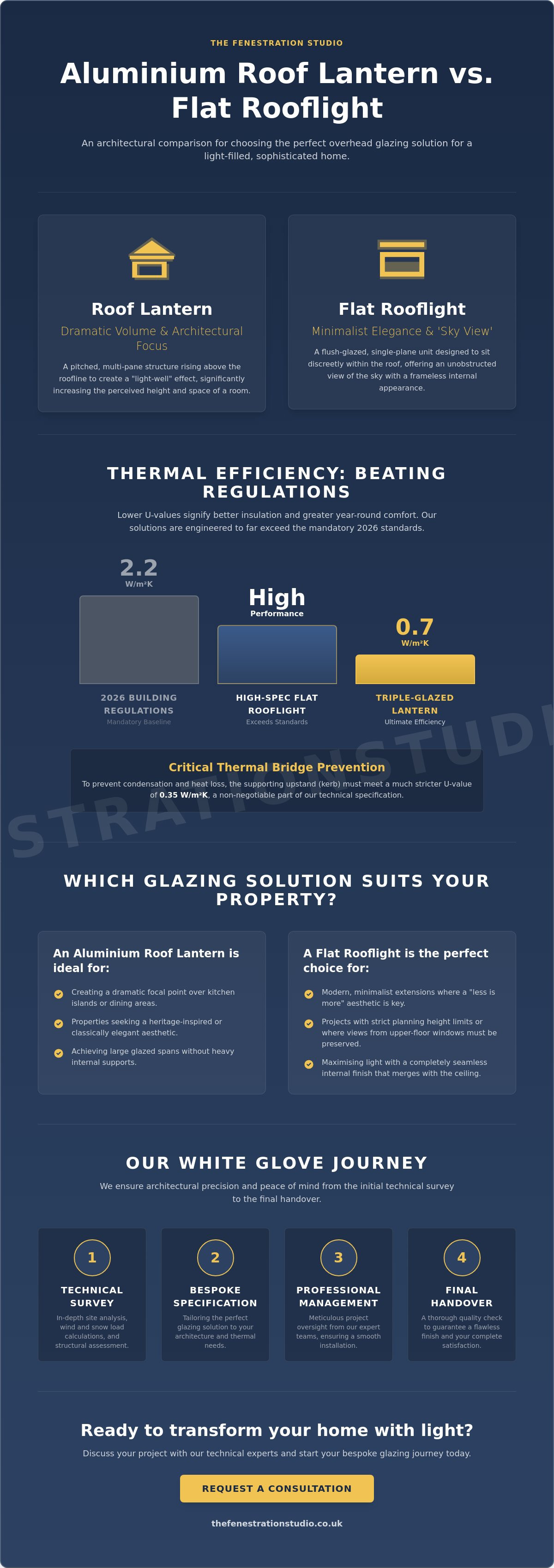
Selection Framework: Which Glazing Solution Suits Your Property?
Selecting between an aluminium roof lantern vs flat rooflight requires a methodical assessment of your property's existing architecture and the intended function of the new space. It's a common mistake to choose based on supply cost alone, but the right specification is defined by ceiling height and light requirements. For instance, extensions with lower ceilings, often around 2.2 to 2.4 metres, benefit significantly from the added vertical volume of a lantern. This architectural "lift" prevents a large flat-roof extension from feeling oppressive, creating an airy atmosphere that a flush unit cannot replicate. Conversely, for a dedicated home office or a minimalist bedroom, the direct, focused light of a flat rooflight is often the more practical choice.
Property style also plays a decisive role in the selection process. Heritage homes and traditional orangeries naturally suit the classic, tiered lines of an aluminium lantern. These structures don't just provide light; they act as a crown for the building, enhancing the external silhouette. For contemporary builds, the goal is often to minimise visual clutter. In these cases, a flat rooflight provides the necessary illumination without interrupting the crisp, clean lines of a modern roofline. Our technical advisors often suggest reviewing your property's orientation before making a final decision, as the path of the sun will dictate which glazing profile provides the most consistent comfort throughout the changing seasons.
The Case for the Aluminium Roof Lantern
Roof lanterns are the definitive choice for large kitchen extensions where a "wow" factor is required. Their primary advantage lies in their ability to capture low-level sun during the shorter winter months, as the pitched glass facets are angled to intercept light that would otherwise bounce off a flat surface. To achieve the best internal layout, we recommend centering the lantern over a key furniture piece, such as a kitchen island or a bespoke dining table. This creates a natural focal point and organises the room's flow with architectural precision.
The Case for the Flat Rooflight
For minimalist modern extensions or properties featuring walk-on roof terraces, the flat rooflight is the superior engineering solution. It offers a subtle enhancement of natural light with virtually no visual intrusion from the exterior. These units are also remarkably easier to maintain; their low profile makes them accessible for cleaning without the need for specialist equipment. For a truly cohesive contemporary aesthetic, we recommend that you pair these units with our aluminium sliding doors. This combination creates a seamless transition between the interior and the garden, maintaining the "less is more" philosophy that defines high-end modern design.
Choosing the correct glazing is a significant investment that requires expert guidance to avoid expensive structural mistakes. If you are ready to move forward with a professional specification, you can book a design consultation with our technical team to ensure your project meets the highest architectural standards.
The White Glove Journey: From Technical Survey to Final Handover
The choice between an aluminium roof lantern vs flat rooflight is merely the first step in a complex architectural journey. At The Fenestration Studio, we move away from the aggressive tactics of standard double-glazing sales, positioning ourselves as a dedicated consultancy partner. Our 'National Standards, Unrivalled Expertise' framework ensures that your project benefits from extensive industry knowledge whilst adhering to the highest engineering benchmarks. This "White Glove Service" begins long before the first glass pane arrives on-site; it starts with a comprehensive technical survey designed to eliminate the risk of expensive structural errors.
Organising the logistics for a high-end installation requires methodical planning. We manage the entire lifecycle of your project, from the initial specification to the final technical handover. By handling the complex coordination between structural engineers and our installation teams, we provide a seamless experience that protects your investment. This professional oversight is essential for navigating the 2026 Building Regulations, ensuring that every component, from the slimline framework to the thermal breaks, performs exactly as specified in your architectural plans.
Avoiding Expensive Mistakes: The Surveying Process
Precision is the foundation of every successful installation. A professional surveyor doesn't just measure the aperture; they assess the structural integrity of your roof joists and the thermal performance of the upstand. As of May 2026, site-built kerbs must achieve a U-value of 0.35 W/m²K to comply with mandatory standards. We ensure your specification accounts for the significant weight of premium glazing, which can lead to structural sagging if handled by a "supply-only" retailer. Overlooking these details can result in corrective costs exceeding £1,500, particularly if a carpenter is required to retrospectively alter the framework at daily rates of £220 to £350.
Your Installation and Aftercare
On installation day, our team operates with a level of technical rigour that mirrors the precision of our engineering. We understand that your home is a sanctuary, not a construction site. Our fitters prioritise cleanliness and professional conduct, ensuring a stress-free experience from arrival to final handover. Once the installation is complete, we provide clear guidance on maintaining your powder-coated aluminium profiles and self-cleaning glass to ensure decades of performance. This methodical approach is why we remain the trusted choice for discerning homeowners across the United Kingdom. If you are ready to transform your living space with architectural precision, you can request a bespoke quote to begin your journey with our expert team.
Realising Your Vision with Architectural Precision
Deciding between an aluminium roof lantern vs flat rooflight is a pivotal choice that defines the character and comfort of your living space. It's the difference between creating an architectural feature with tiered glass facets or achieving a sleek, minimalist sky view. Both solutions require the technical rigour of our Expert Technical Surveying, which is included as standard to ensure your project complies with the latest 2026 Building Regulations. Our durable, slimline aluminium construction provides the structural stability needed for large glass spans whilst maintaining exceptional thermal efficiency.
We believe that high-end glazing should be a stress-free investment. This is why we provide a Comprehensive White Glove Installation Service that handles every technical detail from the initial survey to the final technical handover. You can Book a design consultation to explore our premium roof glazing range and discover how our consultative approach protects you from expensive mistakes. We look forward to helping you transform your home into a bespoke living space with quiet confidence and professional integrity.
Frequently Asked Questions
Do I need planning permission for an aluminium roof lantern in the UK?
Most installations fall under Permitted Development if the lantern doesn't exceed 4 metres in height or project more than 150mm from the roof plane. However, properties in national parks, conservation areas, or listed buildings almost always require a full planning application. It's essential to verify your specific local authority's stance before starting any structural work to avoid legal complications.
Are flat rooflights more energy-efficient than roof lanterns?
Flat rooflights often achieve slightly better thermal performance because they have fewer framework joints where heat can escape. Whilst an aluminium roof lantern vs flat rooflight comparison shows both can meet the 2026 Building Regulations, the minimalist design of a flat unit naturally reduces thermal bridging. Choosing triple glazing for either structure will significantly improve performance, lowering U-values to as little as 0.7 W/m²K.
Which is easier to clean: a roof lantern or a flat rooflight?
Flat rooflights are generally easier to clean due to their accessible, horizontal profile. Because roof lanterns feature multiple pitched facets, they often require professional equipment or self-cleaning glass coatings to maintain clarity. These coatings use UV light to break down organic matter, which rainwater then washes away, reducing the manual maintenance cycle by approximately 75% compared to standard glass.
Can I install a roof lantern on an existing flat roof?
You can install a lantern on an existing roof, provided the structure is reinforced to manage the additional weight. A technical survey is mandatory to assess your current joist spacing and ensure the new upstand meets the 2026 U-value requirement of 0.35 W/m²K. We frequently manage these upgrades by introducing new structural supports to guarantee the long-term safety of the installation.
Will a roof lantern make my room too hot in the summer?
Modern solar control glass prevents overheating by reflecting up to 78% of the sun's heat whilst allowing natural light to pass through. Compliance with Approved Document O ensures that the g-value of the glass is specified to manage solar gain effectively. Integrating electric opening vents further regulates the internal climate by encouraging natural airflow during the warmest months of the year.
What is the typical lifespan of an aluminium roof structure?
High-quality aluminium structures typically last for 40 years or more with minimal maintenance. Unlike uPVC, which can degrade or discolour within 15 to 20 years, powder-coated aluminium is resistant to UV rays and atmospheric corrosion. This longevity makes it a superior investment for homeowners seeking a "fit and forget" solution that maintains its structural integrity for decades.
How long does a professional rooflight installation take?
A standard installation usually takes between 2 and 3 days for a two-person team to complete. This timeframe includes the structural preparation of the aperture, the fitting of the upstand, and the final internal finishing. More complex, bespoke lanterns may take longer, especially if they require intricate leadwork or extensive structural alterations to the existing roof framework to ensure total compliance.
Are aluminium roof lanterns secure against intruders?
Our aluminium lanterns are engineered with security in mind, featuring internal glazing beads and hidden fixings that cannot be accessed from the exterior. We specify toughened or laminated safety glass as standard, which is significantly harder to penetrate than traditional glazing. This robust construction ensures that your home remains secure without compromising the slimline, architectural aesthetic of the framework.