The cheapest quote you receive for your fenestration project is almost certainly the most expensive one you'll ever pay for. When you're planning a significant architectural upgrade, a discrepancy of £3,000 between suppliers isn't just a pricing choice; it's often a signal of missing structural steels or ignored surveying fees. You already know that premium glazing is a long-term investment in your home's value, yet the lack of transparency in the industry can make the initial planning phase feel unnecessarily volatile.
This guide provides a definitive breakdown of the aluminium sliding doors cost UK 2026, ensuring you can budget with precision and professional confidence. We'll move beyond simple per-metre estimates to examine how technical specifications and 2026 building regulations influence your final investment. You'll gain a transparent understanding of price drivers and the bespoke framework required for a stress-free, white-glove installation that secures your property's future.
Key Takeaways
- Understand why ultra-slim aluminium profiles are the superior architectural choice for 2026, providing the structural integrity required for expansive, wide-span openings.
- Learn how to accurately forecast your aluminium sliding doors cost UK 2026 by accounting for frame specifications and the thermal requirements of the Future Homes Standard.
- Avoid the "price per square metre" trap by discovering how the number of sliding panels and track configurations impact your overall project budget.
- Recognise the "hidden" structural logistics and surveying requirements that prevent expensive mistakes and ensure your framework is perfectly aligned.
- Discover how a "White Glove Service" protects your investment, eliminating the long-term costs associated with poor fitting and air leakage.
The UK Aluminium Sliding Door Market in 2026: An Overview
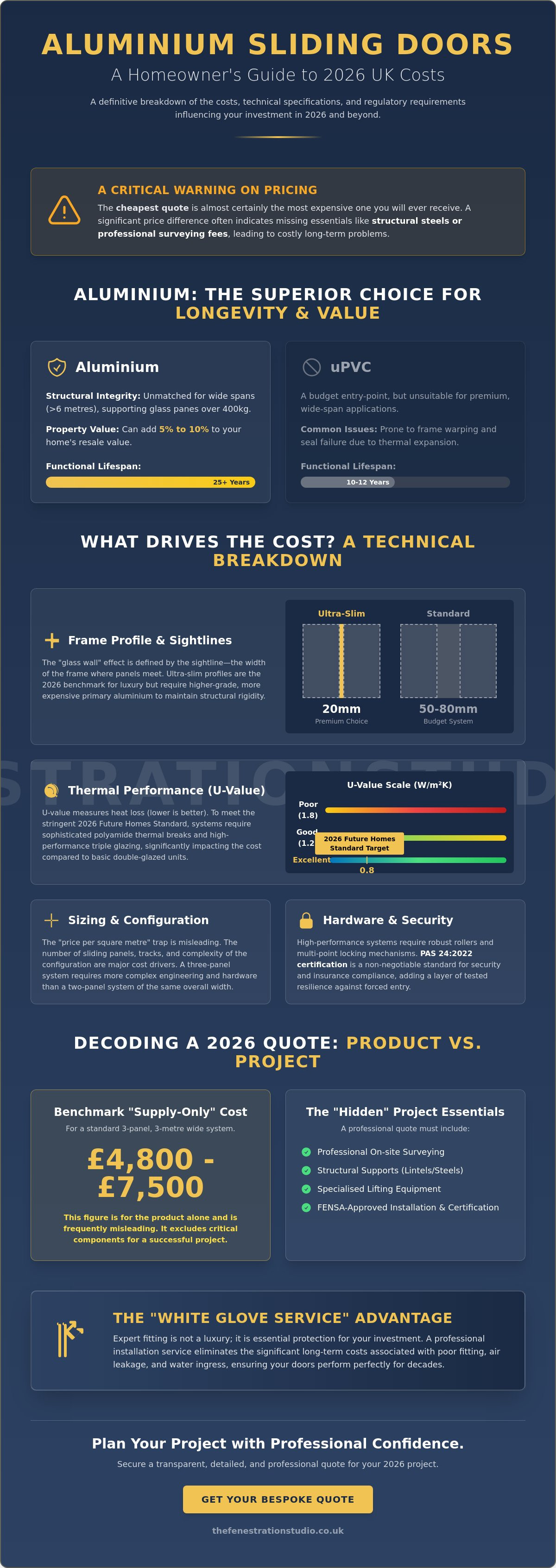
The UK fenestration landscape has undergone a significant transformation. By 2026, the demand for ultra-slim profiles has moved from niche architectural projects into the mainstream premium home sector. Homeowners now prioritise maximum glass-to-frame ratios; sightlines of just 20mm are the new benchmark for high-end installations. This shift directly impacts the aluminium sliding doors cost UK 2026, as engineering these narrow frames requires high-grade primary aluminium rather than cheaper, recycled alloys that lack structural rigidity. Local Expertise. National Standards. This dual focus ensures that while the aesthetic is minimalist, the structural integrity remains uncompromised.
Aluminium remains the undisputed leader for wide-span apertures. While timber offers aesthetic warmth and uPVC provides a budget entry point, neither can match the structural performance of aluminium over a 6-metre span. A standard 3-panel system in 2026 relies on precision-engineered rollers and tracks to manage glass weights that often exceed 400kg per leaf. Understanding window design and components is essential for homeowners to distinguish between a basic retail unit and a high-performance architectural system. Bespoke systems offer superior U-values, often achieving 1.2 W/m²K or lower, which is vital for meeting the latest UK Building Regulations.
Aluminium vs. uPVC: The Real Cost of Longevity
Choosing aluminium is a strategic investment in property equity. uPVC systems often require replacement or significant adjustment within 10 to 12 years due to thermal expansion and frame warping. In contrast, a marine-grade powder-coated aluminium frame typically offers a 25-year functional lifespan with minimal maintenance. For premium UK homes, the presence of high-specification aluminium sliding doors can add between 5% and 10% to the final resale value. Buyers recognise the quality of the thermal break and the security of multi-point locking systems as markers of a well-maintained property.
Market Average Benchmarks for 2026
Industry reports from late 2025 indicate that 78% of premium renovations now specify aluminium over alternative materials. For a standard 3-panel, 3-metre wide system, homeowners should expect the aluminium sliding doors cost UK 2026 to start between £4,800 and £7,500 for the product alone. "Supply-only" figures are frequently misleading; they exclude the specialised lifting equipment and White Glove precision required for a weather-tight installation. A 22% increase in energy costs for aluminium smelting between 2023 and 2025 has stabilised the baseline cost of raw extrusions, making professional, right-first-time installation more critical than ever to avoid expensive mistakes.
Technical Specifications: What Actually Drives the Price?
Engineering precision dictates the investment required for high-end fenestration. When analysing the aluminium sliding doors cost UK 2026, homeowners must look beyond the glass to the structural integrity of the frame. Slimline systems, featuring interlocks as narrow as 20mm, require higher-grade aluminium alloys to maintain rigidity against wind loads. This architectural minimalism isn't merely a style choice; it represents a significant engineering feat that commands a premium over standard 50mm or 80mm profiles. Cheaper systems often rely on bulkier frames to achieve stability, sacrificing the "glass wall" effect that defines modern luxury builds.
Hardware and security specifications also influence the final quote. A robust multi-point locking system is standard for premium products, but the integration of PAS 24:2022 certification adds a layer of tested security that protects your home and satisfies insurance requirements. Security and compliance are non-negotiable; professional installations by FENSA-approved installers ensure that your project meets the stringent building regulations for structural integrity and forced entry resistance. These mechanical components must operate silently and effortlessly, even when supporting glass panes weighing over 400kg.
Thermal Efficiency and U-Values
Thermal transmittance, or U-value, measures the rate of heat transfer through a structure, expressed in W/m²K, where a lower figure indicates superior insulation. To meet the 2026 Future Homes Standard, systems must achieve U-values often as low as 0.8 W/m²K. Reaching these targets involves sophisticated polyamide thermal breaks and high-performance gaskets. Triple glazing is becoming the benchmark for premium installations; however, it adds approximately 10kg per square metre to each pane. This extra weight necessitates heavy-duty stainless steel tracks and reinforced rollers, which naturally increases the project budget.
Aesthetic Options and Bespoke Finishes
The finish of your frames impacts both longevity and price. While standard RAL colours like Anthracite Grey remain cost-effective, bespoke textured finishes or dual-colour options, where the internal and external frames differ, require separate powder-coating processes. For coastal properties within five miles of the sea, marine-grade finishes are essential. These coatings are applied to a thickness of 60 to 80 microns to prevent salt-air corrosion, typically adding 10% to 15% to the frame cost.
Integrated architectural features like flush tracks create a seamless transition between indoor and outdoor spaces. These require advanced drainage channels and precision floor-level integration during the structural phase of your build. To understand how these technical specifications translate to your specific project, you can explore our range of high-performance aluminium sliding doors. Choosing solar control coatings is another wise investment for south-facing elevations, as they reflect up to 70% of solar heat while maintaining high light clarity, preventing the "greenhouse effect" in large glazed extensions.
Sizing and Configuration: Mapping Your Project Budget
The configuration of your aperture defines the structural framework of your investment. While a two-panel system is standard, moving to three or four panels increases the track depth and the precision required for the head and sill. The aluminium sliding doors cost UK 2026 market reflects this technical complexity. Each additional panel requires its own set of rollers, seals, and locking points, which increases both material costs and the time needed for a White Glove installation.
A common mistake is the "price per square metre" trap. Smaller doors often carry a higher cost proportionally. This happens because fixed expenses, such as the initial profile extrusion, powder coating setup, and site logistics, remain constant regardless of the glass surface area. For 2026 projects, we see a 25% price uplift for corner sliding doors. These systems remove the need for a fixed corner post, creating a dramatic architectural "wow factor" that requires sophisticated cantilevered structural support. Automated sliding systems represent the luxury tier; they use integrated motor drives and sensors to move heavy panes effortlessly, adding a premium to the final specification.
Standard vs. Oversized Glass Panes
Architectural trends for 2026 favour "jumbo" glass sheets to maximise unobstructed views. These panes require specialised handling and logistics. Standard 6mm toughened glass is insufficient for panels exceeding 2.5 metres in width. You must specify 8mm or 10mm glass to maintain structural integrity under wind loads. This increase in thickness adds significant weight, often necessitating crane hire for a safe installation. All glass must comply with the UK Building Regulations for energy efficiency, specifically Part L, which mandates strict U-values. Explore our aluminium sliding doors to see how we balance these technical requirements with aesthetic goals.
Opening Configurations and Track Systems
The choice between monorail, double, and triple tracks dictates how your space functions. Monorail systems offer a cleaner look with one fixed pane and one sliding pane. Triple tracks allow two-thirds of the aperture to open, though they require a wider floor rebate. Lift and slide mechanisms, which use a handle to engage rollers and lift the door off the seals, typically cost 15% to 20% more than standard inline systems. For those seeking a seamless transition, pocket doors hide the panels within a wall cavity. This requires early-stage coordination with your structural engineer to budget for the hidden track framework. These mechanical choices are a primary driver of the aluminium sliding doors cost UK 2026 for high-end residential projects.
Installation and Structural Logistics: The "Hidden" Costs
The headline figure for your aluminium sliding doors cost UK 2026 rarely reflects the total project investment. Technical logistics and site-specific requirements represent the difference between a successful architectural statement and a compromised installation. A premium project requires a consultative approach that accounts for every structural variable before a single frame is manufactured.
Professional surveying acts as your primary insurance policy. A bespoke manufacturing process allows for zero margin of error; measurements must be millimetre-perfect to accommodate structural tolerances and thermal expansion. Our "White Glove Service" begins here, ensuring that the technical specification aligns with the physical reality of your masonry.
The Surveying and Specification Process
Detailed technical drawings prevent expensive on-site delays by identifying potential clashes with internal finishes or external drainage systems. This stage ensures the threshold sits flush with your interior flooring, creating that seamless transition found in high-end architectural journals. To ensure your project starts with this level of precision, you can book a design consultation with our technical team to review your site requirements.
Structural integrity is another variable that impacts the final bill. If you are widening an existing opening, you will require a structural engineer to specify the correct steel lintel. Residential engineering calculations typically cost between £400 and £1,200 depending on the complexity of the span. Access also dictates the budget. Large-format glass panels are exceptionally heavy. If your property lacks wide side access, we must budget for a spider crane or specialist vacuum lifting equipment, which can add £600 to £1,500 to the daily installation rate.
Building Regulations and Certification
Compliance with Part L of the Building Regulations in 2026 is non-negotiable for any major renovation. These modern standards focus heavily on thermal efficiency and carbon reduction, directly influencing the aluminium sliding doors cost UK 2026 by requiring high-performance glazing units. Most installations now require "trickle vents" within the frame to meet background ventilation rules, unless your home utilises a mechanical ventilation heat recovery (MVHR) system.
Once the installation is complete, your FENSA or CERTASS certification provides the legal proof of compliance required for future home sales. Finally, you must budget for "making good." This involves professional plastering around the new aperture, flooring adjustments, and external rendering. These finishing touches ensure your new fenestration integrates perfectly with the existing building fabric. Avoid common installation pitfalls by securing a professional site assessment early in your planning phase.
Request a technical quote to receive a transparent breakdown of your specific installation and structural requirements.
The White Glove Service: Why Expert Fitting Saves Money
A low initial quote often masks a lack of technical precision. When you calculate the total aluminium sliding doors cost UK 2026, you've got to factor in the long-term price of poor installation. Data from industry surveys indicates that up to 25 per cent of a door's thermal efficiency can be lost through inadequate perimeter sealing. A budget fitment leads to air leakage and structural movement that nullifies the benefits of premium glazing. The Fenestration Studio manages the entire project lifecycle to prevent these issues. We take you from a rigorous technical survey to a structured aftercare programme. This ensures your investment remains protected for the next 25 to 30 years. We deliver a national standard of engineering through dedicated local expertise.
Our White Glove Service isn't just about the installation day. It's a comprehensive framework designed to eliminate the stress of home improvement. We coordinate every detail, from the structural opening requirements to the final weather-tight seals. This methodical approach prevents the "hidden costs" that arise when builders and glaziers aren't in sync. By choosing a specialist partner, you're investing in a professional handover that includes a full demonstration of the locking mechanisms and track maintenance. It's about ensuring your doors perform as well in ten years as they do on day one.
Avoiding the 7 Most Expensive Glazing Mistakes
Choosing a system based on price alone whilst ignoring thermal performance is a common pitfall. By 2026, failing to meet stringent Building Regulations can result in expensive remedial works or issues when selling your property. Incorrect track drainage is another frequent failure. Without a bespoke drainage strategy, water ingress causes internal damp and ruins expensive flooring. Achieving a true flush finish requires exact structural planning. If floor levels aren't calculated to the millimetre during the survey, you'll end up with a permanent trip hazard or an unsightly step that ruins the architectural flow of your living space.
The Fenestration Studio Approach
We're committed to transparent, honest advice. Our team rejects the high-pressure sales tactics typical of the double-glazing industry. We act as your architectural consultants. Being an independently run family business means we offer project continuity that national chains can't match. You'll work with the same experts from the initial design to the final handover. We protect your investment with comprehensive warranties and a professional demonstration of your new system's features. To begin your journey with a partner who values precision, request a bespoke quote to see how we can transform your home with a high-performance solution.
Secure Your 2026 Architectural Vision
Navigating the aluminium sliding doors cost UK 2026 landscape requires more than just comparing bottom-line figures. You've seen how technical specifications and structural logistics dictate the final investment. Avoiding expensive mistakes starts with expert specification at the survey stage. It's about protecting your home's integrity and ensuring your slimline frames perform for decades. Quality fenestration is a long-term asset, not a short-term expense.
At The Fenestration Studio, we provide a dedicated White Glove Service that spans from the initial technical survey to comprehensive aftercare. We combine nationwide coverage with local installation teams to ensure your project meets national standards without losing that essential local insight. Our experts help you navigate complex structural requirements to ensure your investment remains secure. Local Expertise. National Standards.
Take the first step toward a seamless home transformation. Request a bespoke quote for your 2026 sliding door project and let's ensure your architectural vision is delivered with professional rigour. Your premium home deserves a finish that lasts.
Frequently Asked Questions
How much do aluminium sliding doors cost per metre in the UK for 2026?
In 2026, the aluminium sliding doors cost UK 2026 typically ranges from £1,200 to £2,500 per linear metre for premium architectural systems. This price bracket reflects the high-grade engineering required to support expansive glass panes whilst maintaining slim sightlines. Costs fluctuate based on the specific framework chosen and the complexity of the thermal break technology integrated into the profile.
Is triple glazing worth the extra cost for sliding doors?
Triple glazing offers a 40% improvement in thermal efficiency compared to standard double-glazed units, making it a vital specification for north-facing elevations. While the initial investment is usually 15% to 20% higher, the reduction in heat loss and superior acoustic insulation provides long-term value. It's a strategic choice for homeowners aiming for a U-value of 0.8 W/m²K or lower to meet future building regulations.
Do I need a structural engineer to install sliding patio doors?
You'll need a structural engineer if your project involves widening an existing opening or creating a new one in a load-bearing wall. They provide the essential calculations for the steel lintel required to support the weight of your masonry. Skipping this step is an expensive mistake that can lead to structural sagging, which eventually prevents the sliding panels from gliding smoothly along their tracks.
How long does the installation of aluminium sliding doors typically take?
A standard three-pane installation usually takes 1 to 2 days to complete under our White Glove Service protocol. If your design includes recessed "flush" tracks or requires specialist lifting equipment for oversized glass, the timeline may extend to 4 days. Precision is the priority here; rushing the levelling process often leads to mechanical failure within the first 12 months of use.
What is the difference in cost between bifold and sliding doors?
High-end sliding doors often cost 10% to 15% more than bifold doors because they require thicker, toughened glass to span larger widths. While bifold doors have more moving hardware, the engineering required to move a single sliding pane weighing over 400kg is more complex. You're paying for the uninterrupted view and the sophisticated roller systems that allow for effortless operation despite the significant weight.
Are aluminium sliding doors more secure than French doors?
Modern aluminium sliding doors are inherently more secure than French doors because they're built into a continuous track system that prevents the doors from being lifted. French doors rely on a central meeting point which can be a structural weak spot if not fitted with high-security bolts. Our sliding systems utilise multi-point locking mechanisms and internal glazing beads, ensuring they meet the rigorous PAS 24 security standards.
Can I install slimline sliding doors in a coastal property?
You can install slimline systems in coastal areas, but you must specify a marine-grade powder coating of at least 60 microns to prevent salt corrosion. Properties within 5 kilometres of the shoreline are at high risk of finish degradation without this protection. We always recommend pre-anodised aluminium frames for maritime environments to ensure the framework remains pristine despite the aggressive salt spray.
What hidden costs should I budget for when replacing old patio doors?
Homeowners should budget an additional 15% for project contingencies such as structural steelwork, VAT, and professional waste disposal fees. If your doors are on an upper floor, scaffolding can add £600 to £1,200 to your total expenditure. Don't forget to account for internal making-good, as new tracks often have different depths than your original doors, requiring adjustments to your flooring or plasterwork.