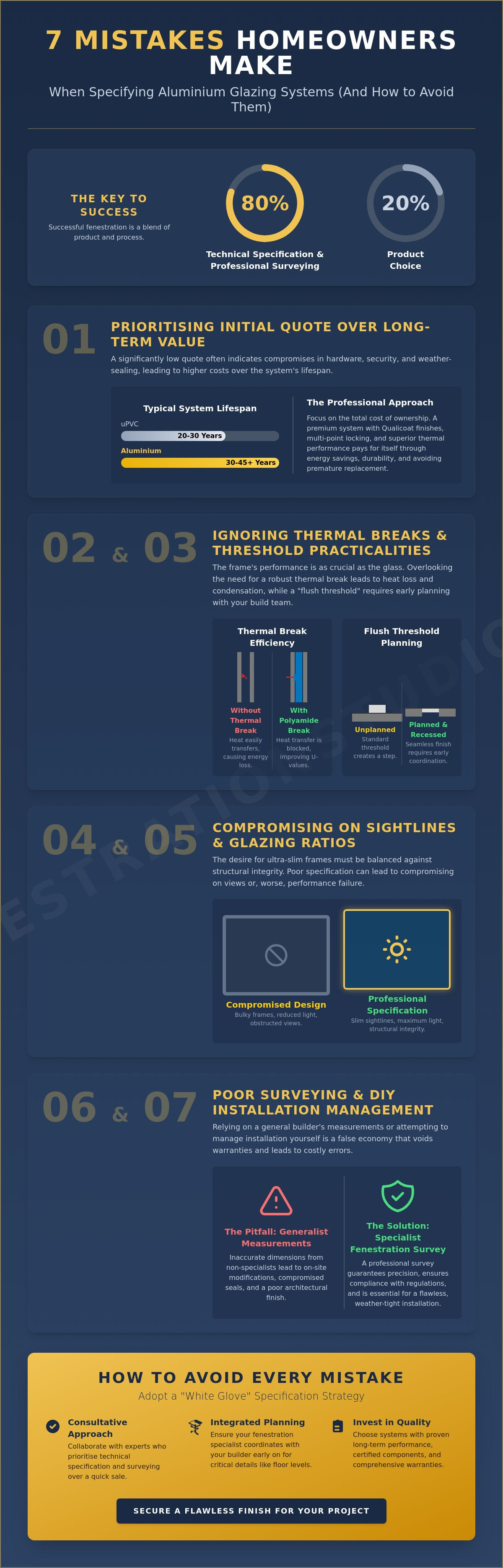
The most expensive aluminium window you'll ever buy is the one you're forced to replace because it fails to meet the 1.2 W/m²K U-value mandate required by current Part L regulations. It's a common misconception that a premium price tag automatically guarantees technical compliance or long term thermal comfort. We understand that you want a sleek, architectural aesthetic but worry that slimline frames might compromise your home's warmth or fall foul of unreliable installation practices. Successful fenestration is actually 20% product choice and 80% technical specification and professional surveying.
You'll discover how to identify genuine thermal breaks and manage the technical pitfalls that often derail high-end glazing projects. This article explores the 7 Mistakes Homeowners Make When Specifying Aluminium Systems (And How to Avoid Them), providing the professional clarity you need for a flawless finish. We will break down why the 2026 updates to building regulations have changed the specification landscape and how to secure a high-performance result that stays on schedule and delivers a sophisticated, architectural look.
Key Takeaways
- Learn why prioritising the lowest initial quote often leads to hidden costs in inferior hardware and gaskets that compromise your home’s long-term security.
- Understand the technical necessity of high-performance thermal breaks and how early planning for floor levels is essential to achieving a true flush threshold finish.
- Discover the precise balance required between slimline sightlines and glazing ratios to flood your space with light whilst maintaining structural performance.
- Identify the 7 Mistakes Homeowners Make When Specifying Aluminium Systems (And How to Avoid Them), including why you should never rely on a general builder’s measurements for a specialist survey.
- Explore how a consultative "White Glove" strategy ensures your project adheres to national standards whilst benefitting from dedicated local expertise.
Mistake #1: Prioritising Initial Quote Price Over Long-Term Performance
Price is a poor proxy for value in the fenestration industry. It's one of the most common 7 Mistakes Homeowners Make When Specifying Aluminium Systems (And How to Avoid Them). Whilst a standard-sized uPVC window might cost between £325 and £600 to install, an equivalent aluminium unit typically ranges from £475 to £1,000. When a quote arrives significantly below these market averages, it rarely indicates a bargain. Instead, it usually signals a compromise in the technical specification of the frame, the hardware, or the weather-sealing components. High-performance systems rely on specific Aluminium alloys that provide the structural integrity required for ultra-slim sightlines without sacrificing durability.
Cheaper systems often cut costs by using inferior gaskets and generic, non-branded hardware. These components are the first to fail, leading to draughts, water ingress, and mechanical issues within just a few years. Professional fenestration is a bespoke service; it's not a retail commodity. Attempting to save money through "supply-only" deals often results in hidden costs during installation. Without a specialist survey, the risk of technical hitches increases, often requiring expensive on-site modifications that void warranties and compromise the architectural finish.
The "Cheap Quote" Trap: What is Missing?
Low-cost aluminium often lacks the rigorous powder coating standards required for longevity. Premium systems adhere to Qualicoat standards, ensuring the finish doesn't fade or peel under UV exposure. Security is another casualty of budget specifications. High-end aluminium windows include sophisticated multi-point locking systems as standard, whereas budget alternatives may use flimsy, single-point mechanisms. Standardised sizes are also a hallmark of "cheap" quotes. These rarely align with the precise requirements of a bespoke architectural project, forcing you to compromise your design to fit the product.
Total Cost of Ownership vs. Purchase Price
The true cost of a window is measured over its lifecycle. Aluminium systems have a lifespan of 30-45 years, significantly outperforming the 20-30 year expectancy of uPVC. When you calculate the annual cost of service, the premium for aluminium is often less than £5 per window per year. More importantly, the 2026 updates to Part L Building Regulations mandate a U-value of 1.2 W/m²K for replacement windows. Investing in a system with superior thermal breaks and triple glazing can reduce energy bills by up to 30%. A higher initial investment effectively pays for itself through lower monthly outgoings and the avoidance of premature replacement costs.
Mistake #2 & #3: Ignoring Thermal Breaks and Threshold Practicalities
Modern architectural design often demands vast expanses of glass, yet many homeowners overlook the technical framework that makes these features viable in the UK climate. Mistake #2 involves selecting systems based on glass appearance while ignoring the U-value of the frame itself. As of 2026, Part L of the Building Regulations mandates a maximum U-value of 1.4 W/m²K for replacement doors. Achieving this requires more than just high-spec glazing; it necessitates a sophisticated internal framework. Without a robust thermal break, even the most expensive triple-glazing will feel cold to the touch and suffer from persistent condensation during British winters.
Mistake #3 centres on the "flush threshold" dream. Homeowners frequently envision a seamless transition from the kitchen to the patio but fail to account for the necessary floor level adjustments before the order is placed. This is one of the most critical 7 Mistakes Homeowners Make When Specifying Aluminium Systems (And How to Avoid Them). A true flush finish requires the track to be recessed into the floor, a process that must be coordinated with your builder and surveyor long before the installation team arrives on site.
Thermal Efficiency: Beyond the Glass
A polyamide thermal break is a high-performance plastic strip positioned between the inner and outer aluminium profiles to effectively stop the transfer of heat and prevent internal condensation. When specifying aluminium bifolding doors, the frame specification is just as vital as the glass for meeting thermal targets. You should also ensure your system uses "warm edge" spacer bars; these small components sit between the glass panes and can improve the overall window U-value by up to 10% compared to traditional aluminium spacers.
Achieving the Perfect Flush Threshold
To achieve a professional architectural finish, internal and external floor levels must be decided at the concept stage. There is a significant technical difference between a weathered track, which features a small upstand to block wind-driven rain, and a non-weathered low-profile track. If you insist on a completely flat transition, you must install a bespoke drainage channel, such as an ACO drain, immediately outside the door. This prevents water from pooling against the frame and ensures your home remains watertight. If you're unsure how these levels will interact with your existing structure, you can book a design consultation to review your technical drawings with a specialist.
Mistake #4 & #5: Compromising on Sightlines and Glazing Ratios
The primary architectural appeal of aluminium is its exceptional strength-to-weight ratio. This property allows for significantly narrower frames than timber or uPVC, yet many projects fail to capitalise on this advantage. Mistake #4 in our guide to the 7 Mistakes Homeowners Make When Specifying Aluminium Systems (And How to Avoid Them) is selecting profiles that are unnecessarily thick. This often occurs when the homeowner focuses on the price of individual units rather than the collective visual impact. When you choose bulky frames, you effectively pay for a premium material only to obscure the very garden views you intended to frame.
Mistake #5 involves an incorrect glass-to-frame ratio. Homeowners often underestimate how much the 'daylight opening' (the clear glass area) reduces as frame thickness increases. For instance, in a standard three-panel door configuration, switching from a standard profile to a slimline system can increase the glass area by up to 12%. This difference is not merely aesthetic; it fundamentally changes how natural light interacts with your interior space and how the room feels throughout the day.
The Aesthetic Impact of Slimline Profiles
There is a significant technical difference between the sightlines of aluminium sliding doors and bifolding systems. Whilst bifolds offer the benefit of a 100% clear opening, they typically have much thicker vertical sightlines where the doors meet, often exceeding 120mm. In contrast, premium sliding systems can achieve interlock widths as narrow as 20mm. If your priority is a minimalist look whilst the doors are closed, the interlock measurement is the most critical technical specification to review. Achieving these ultra-slim sightlines requires professional engineering to ensure the structural integrity of the building is maintained under wind loads.
Glazing Ratios and Natural Light
Calculating the daylight opening is essential for any project aiming for a high-end architectural finish. However, as you increase the glazing ratio, you must also consider solar gain. Large expanses of glass can lead to overheating if not specified with solar control coatings. This is particularly relevant for south-facing elevations where the "greenhouse effect" can make a room uncomfortable during summer months. Whether you are installing heritage style windows with their characteristic glazing bars or modern floor-to-ceiling casements, maintaining consistent sightlines across the entire property is vital. A mix of different frame depths can create a cluttered visual effect that detracts from the home's overall value.
Mistake #6 & #7: Poor Surveying and DIY Installation Management
High-end fenestration projects often falter at the final hurdle due to a lack of technical oversight during the transition from design to reality. Mistake #6 involves relying on a general builder's measurements rather than a specialist survey. Whilst a builder is skilled at structural work, their tolerances are typically measured in centimetres; aluminium systems require precision measured in millimetres. If a bespoke frame arrives even 5mm too large for the structural opening, it cannot be "trimmed" on-site like a timber door. This leads to expensive delays, structural modifications, and often, a compromised aesthetic where the frame is forced into a space it wasn't designed for.
Mistake #7 is the attempt to manage multiple trades without a central fenestration expert. This is a primary entry in the 7 Mistakes Homeowners Make When Specifying Aluminium Systems (And How to Avoid Them). When the builder, the floorer, and the glazier are not in direct communication, the responsibility for technical interfaces falls on the homeowner. This often results in the "Survey Gap," where the product is manufactured correctly to the builder's dimensions, but fails to account for the final floor finishes or drainage requirements discussed in previous sections.
The Critical Importance of a Professional Survey
A specialist surveyor does not just measure the width and height of a hole in the wall. They assess the structural integrity of the lintels, the verticality of the apertures, and the specific tolerances required for the chosen system's expansion and contraction. They must distinguish between the "structural opening" (the raw hole) and the "manufacturing size" (the final product dimensions). A manufacturing error of just 2mm can lead to a £10,000 sliding door becoming entirely inoperable as the rollers fail to align perfectly with the track. Professional surveyors also ensure compliance with Part F ventilation requirements, confirming that trickle vents are correctly specified to match or exceed the original airflow levels.
Installation: The Difference Between "Fitting" and "Engineering"
Installing premium aluminium is an engineering task, not a simple fitting job. These systems require specific perimeter sealing techniques and precise levelling to ensure the hardware operates smoothly for its 45 year lifespan. Poor installation is the leading cause of draughts, water leaks, and premature hardware failure. By utilising a "White Glove" installation service, you ensure that every gasket is seated correctly and every locking point is perfectly aligned. This professional approach is also the only way to validate your product warranty and receive the necessary FENSA certification. To ensure your project is handled with this level of precision, you should request a professional technical survey before finalising your order.
How to Avoid Every Mistake: The White Glove Specification Strategy
The complexities of modern fenestration require a methodical approach that prioritises technical precision over aggressive sales tactics. By understanding the 7 Mistakes Homeowners Make When Specifying Aluminium Systems (And How to Avoid Them), you've already taken the first step toward a successful architectural project. Our "White Glove" strategy is designed to bridge the gap between your design vision and structural reality. We operate on a simple principle: Local Expertise. National Standards. This means you receive the dedicated attention of a local team backed by the rigorous engineering standards expected of premium glazing systems.
Our process follows a disciplined three-step lifecycle. First, we conduct a technical consultation to align your design goals with current building regulations. Second, a specialist surveyor performs a millimetre-perfect assessment of your structural openings. Finally, we execute a precision installation followed by an expert handover. This systematic framework removes the burden of trade management from the homeowner. It places every technical specification in the hands of a dedicated project manager who is entirely in control of the project lifecycle.
Consultation and Design: Getting it Right from Day One
The journey begins by navigating the our aluminium products range to find the profile that suits your home's unique character. We don't just look at aesthetics; we evaluate property orientation to determine the necessary solar control and thermal performance. This ensures your slimline frames are as functional as they are beautiful. You can book a design consultation today to review your plans with a specialist who understands the nuances of UK building codes and architectural trends.
Peace of Mind with Expert Aftercare
A premium project doesn't end when the last glass panel is polished. Our commitment to quality extends into a comprehensive aftercare programme that protects your long-term investment. This includes a robust warranty that is only valid because our own specialists handled the installation from start to finish. We encourage you to read our product reviews to see how this methodical approach has delivered consistent results for homeowners across the country. When you're ready to move away from the uncertainty of "cheap" quotes and toward a professionally managed architectural solution, you can Request a Quote to begin your bespoke project.
Elevate Your Home with Precision Engineering
Achieving a high-end architectural finish requires more than just selecting a premium product; it demands rigorous technical oversight at every stage. We have detailed how prioritising long term thermal efficiency and millimetre-perfect surveying prevents the most common 7 Mistakes Homeowners Make When Specifying Aluminium Systems (And How to Avoid Them). By focusing on bespoke architectural specification rather than the cheapest initial quote, you protect your property from the risks of condensation, draughts, and mechanical failure. Our White Glove Installation Service ensures that your project meets national standards whilst benefiting from our dedicated local expertise.
You don't have to navigate these complex technical requirements alone. Our team is here to act as your expert mentor, ensuring your vision is realised without compromise. Book a Design Consultation for Your Aluminium Project to begin your journey toward a warmer, brighter, and more sophisticated home. Your perfect architectural finish is well within reach when every detail is managed with professional integrity.
Frequently Asked Questions
What is the most common mistake when buying aluminium windows?
The most frequent error is failing to verify that the system meets the 1.2 W/m²K U-value standard required by the May 2026 Building Regulations. Homeowners often focus on the frame colour whilst ignoring the thermal performance, which leads to higher energy bills and potential compliance issues. This is a key entry in the 7 Mistakes Homeowners Make When Specifying Aluminium Systems (And How to Avoid Them).
Can I install aluminium sliding doors myself to save money?
Attempting a DIY installation is highly discouraged because aluminium systems require specialist engineering rather than simple fitting. A manufacturing or alignment error of just 2mm can prevent large sliding doors from gliding correctly or sealing against the weather. Professional installation is also a mandatory requirement to validate your product warranty and secure the necessary FENSA certification for your property.
Why are aluminium windows more expensive than uPVC?
Aluminium costs 40% to 50% more than uPVC because the raw material is more durable and the manufacturing process is entirely bespoke. Whilst a standard uPVC window might cost £325 to £600, an aluminium equivalent typically ranges from £475 to £1,000. However, aluminium has a 45 year lifespan, making the long term cost per year almost identical to cheaper, shorter lived alternatives.
What is a thermal break and do I really need one?
A thermal break is a polyamide strip that separates the internal and external aluminium profiles to stop heat transfer. You absolutely need one to prevent internal condensation and meet Part L energy efficiency targets. Without this barrier, your frames will become cold enough to pull moisture from the internal air, causing damp issues and significantly reducing the thermal comfort of your room.
How do I ensure my new bifold doors have a flush threshold?
Achieving a flush threshold requires you to decide on your final internal and external floor levels before the technical survey takes place. You must ensure the track is recessed into the floor structure and that a dedicated drainage channel, such as an ACO drain, is installed immediately outside. This prevents water ingress whilst maintaining the seamless architectural transition between your indoor and outdoor spaces.
What should I look for in a professional window survey?
A professional survey should provide millimetre perfect measurements and a detailed assessment of the structural lintels and apertures. It must account for specific tolerances to ensure the product fits the structural opening without on-site modifications. The surveyor should also confirm that the new system complies with Part F ventilation standards by matching or exceeding the original trickle vent airflow.
How long does a typical aluminium system installation take?
A standard installation for a single set of sliding or bifolding doors typically takes 1 to 2 days to complete. For a more comprehensive project involving a whole house of windows, you should expect the team to be on-site for 3 to 5 days. This deliberate pace ensures every gasket is seated correctly and the hardware is perfectly aligned for long term operation.
Do aluminium doors require a lot of maintenance?
Aluminium doors are exceptionally low maintenance and only require a basic cleaning routine to stay in peak condition for decades. You should wipe the frames with warm soapy water every 3 to 4 months and ensure the tracks are kept free of grit and debris. Applying a silicone based lubricant to the moving parts once a year is usually sufficient to maintain a smooth, effortless operation.