Could a single millimetre measurement error really result in £5,000 of wasted materials and a six-week delay to your build? For premium aluminium glazing, the margin for error is non-existent. Understanding what a professional survey looks like is the vital first step in moving from architectural drawings to a flawless physical reality. While a standard RICS report assesses general property value, a technical fenestration survey is a bespoke engineering assessment designed to mitigate every structural risk.
You likely already recognise that high-end slimline systems demand a level of precision that traditional timber or uPVC windows do not. It's common to feel concerned about structural readiness, especially when dealing with the tight tolerances of modern minimalist frames. This article will demonstrate the critical differences between a basic inspection and a high-precision technical survey. We'll outline the exact criteria required for a successful installation, giving you total confidence that your bespoke products will fit perfectly upon arrival.
Key Takeaways
- Understand why a standard RICS property inspection lacks the technical depth required for bespoke aluminium manufacturing and how a specialist survey ensures long-term structural integrity.
- Discover exactly what a professional survey looks like by exploring the advanced toolkit—including laser levels and digital callipers—used to account for thermal expansion and structural movement.
- Learn how high-precision data prevents the expensive mistakes associated with poor fitment, ensuring your premium glazing delivers a seamless "White Glove" installation experience.
- Find out how to prepare your property effectively to ensure surveyors have the unobstructed access required for millimetre-perfect technical specifications.
- Gain insight into the methodical transition from site survey to bespoke manufacturing, where rigorous engineering data is transformed into high-performance architectural reality.
Defining the Professional Survey: General vs. Technical Fenestration
A premium architectural project demands more than a tape measure and a notepad. Understanding what a professional survey looks like starts with separating the sales process from the engineering phase. Whilst many homeowners receive a "quote" based on approximate dimensions, these figures are purely for budgetary guidance. They don't represent the final manufacturing data required for bespoke aluminium fabrication. A professional survey is a technical audit, not a sales pitch.
The surveyor acts as a technical consultant. Their role involves evaluating structural integrity, drainage paths, and floor levels to ensure the final product performs as intended. They must ensure every installation complies with the June 2022 updates to Building Regulations Part L, which mandate strict U-values for thermal efficiency. This process involves assessing the performance of Insulated glazing units to ensure the specific glass and frame combination meets the thermal requirements of your unique property. Local Expertise. National Standards.
The RICS Property Survey vs. The Glazing Survey
Homeowners often confuse a RICS Home Survey with a fenestration survey. They serve different masters. A RICS surveyor identifies legal issues, damp, or structural movement to protect your financial investment. In contrast, a glazing surveyor focuses on fabrication and millimetre-perfect precision. They measure the structural opening because aluminium frames have zero tolerance for error. If you're renovating a property purchased within the last 12 months, you'll likely need both. One secures the building; the other ensures the bespoke products fit it perfectly. You can request a quote to begin this transition from general property assessment to technical glazing specification.
The "Expensive Mistake" of Skipping a Professional Survey
Skipping a professional site survey is a gamble with high stakes. In bespoke aluminium production, a 5mm discrepancy can render a £5,000 sliding door entirely useless. Manufacturing errors usually stem from using non-professional site measurements that fail to account for "out of square" openings or varying floor heights across a large span. These errors lead to site delays and significant waste. Technical Specification is the essential bridge between design and installation. Without this rigorous data, the risk of installation failure increases significantly. A professional survey ensures that the vision on the architectural drawings matches the reality of the brickwork.
- Precision: Measurements are taken to the millimetre, accounting for structural tolerances.
- Specification: Detailed assessment of wind loads, drainage requirements, and thermal performance.
- Safety: Ensuring all glass specifications meet BS 6206 impact ratings for safety and security.
By investing in a professional survey, you're not just buying windows; you're securing a White Glove Service that guarantees a stress-free installation. This methodical approach is what a professional survey looks like in the premium sector, moving away from "rough guesses" towards engineering certainty.
The Anatomy of a High-End Technical Glazing Survey
A professional survey isn't a quick tape-measure exercise. It's a comprehensive structural assessment. When our surveyors arrive on-site, they follow a methodical framework designed to eliminate the project delays typically caused by poor initial measurements. They don't just look at the aperture; they examine the building's skeletal integrity. This level of detail defines what a professional survey looks like in the premium sector.
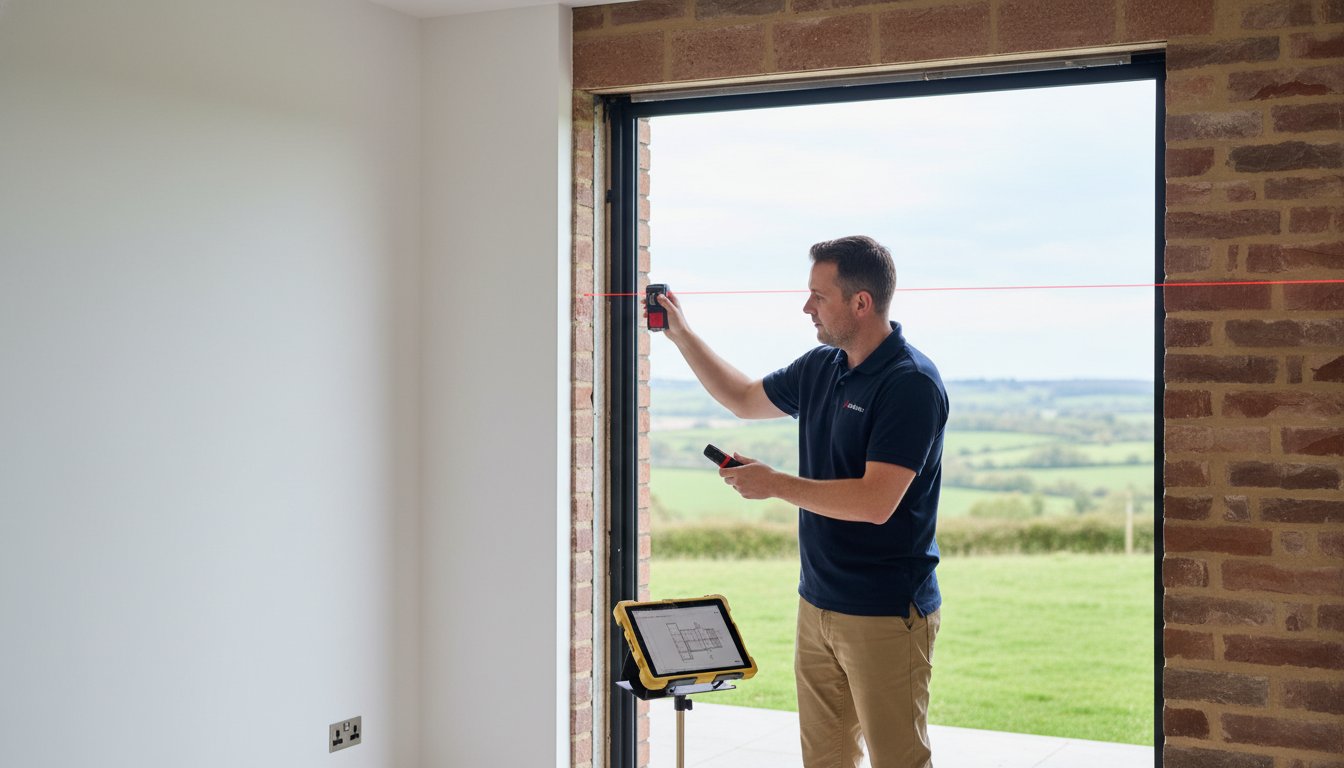
The toolkit reflects this rigour. We use Class II laser levels to establish a true datum line across the entire elevation, ensuring that even if the floor is uneven, the glass remains perfectly level. Digital callipers measure existing frame depths to a 0.1mm tolerance, while thermal imaging cameras identify existing cold spots or damp bridges. This allows us to advise on whether your new aluminium windows require specific thermal breaks or enhanced insulation to meet current Part L building regulations.
Logistics are equally vital. For large-span projects, we map the path from the delivery vehicle to the aperture. If a 300kg pane of glass needs to travel through a narrow side gate or over a finished lawn, the surveyor notes these constraints now. This prevents the expensive mistake of a delivery team arriving with units that cannot physically reach the installation point. We assess the load-bearing capacity of existing lintels and check cill requirements to ensure water is diverted away from the masonry correctly.
Measuring Beyond the Opening
Squareness is rarely found in British architecture. A professional surveyor takes a minimum of three measurements for both width and height. This triangulation identifies if an opening is bowed or out of plumb. We also assess the reveal depth, calculating exactly how much space is needed for internal plastering or external rendering. We look for hidden obstructions like recessed downpipes, low soffits, or internal furniture that could interfere with a slimline frame's operation.
The Technical Specification Document
The output of this process is a detailed Technical Specification Document. This isn't a handwritten note; it's a professional report featuring CAD drawings and precise manufacturing instructions. It specifies glass performance, such as solar control coatings for south-facing elevations or acoustic laminates for properties near busy roads. We also select hardware and drainage paths based on local exposure levels to ensure long-term performance. If you're ready to move beyond guesswork, you can book a design consultation to start your technical assessment and see exactly what a professional survey looks like for your home.
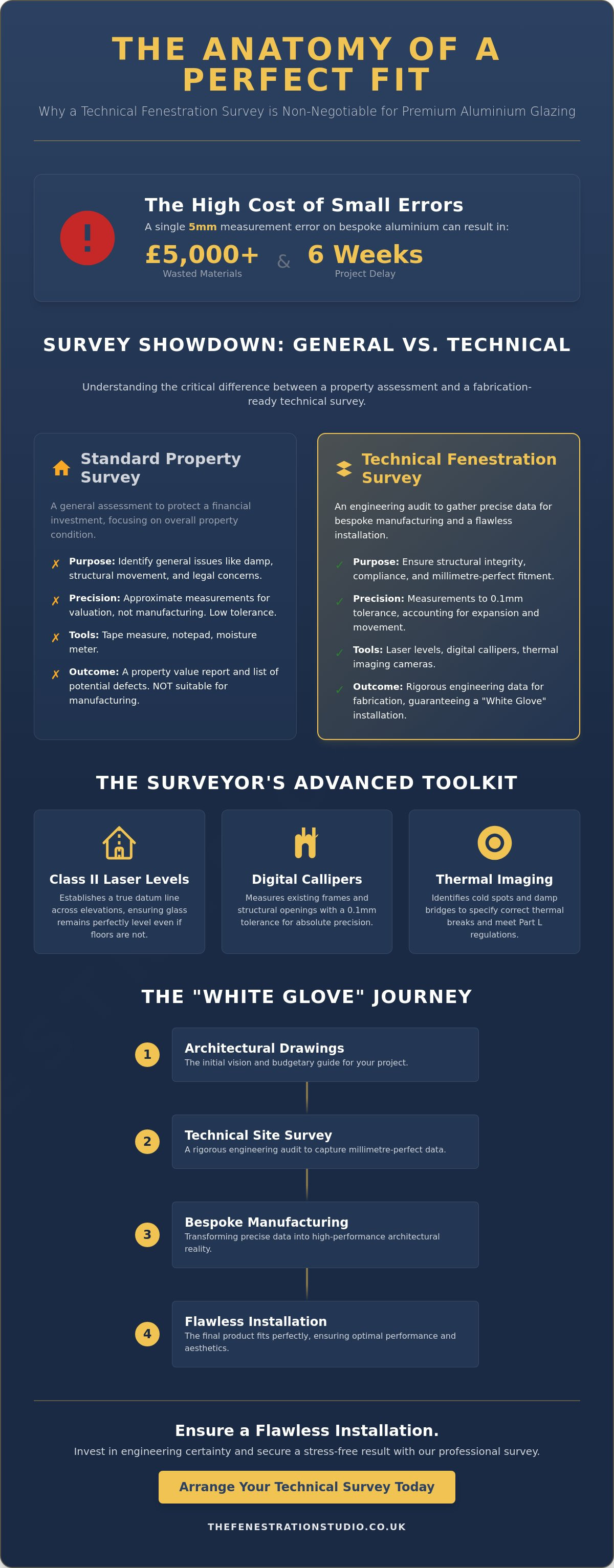
Why Precision Surveying Prevents Expensive Installation Failures
A professional survey serves as the technical bridge between architectural vision and structural reality. In our White Glove installation framework, the survey isn't a mere measurement exercise; it's a comprehensive risk assessment. Precision at this stage is what separates a seamless, high-end finish from a problematic installation that requires constant remedial work. Professional surveyors must account for the physical properties of materials, specifically how aluminium frames react to the environment. Aluminium has a linear thermal expansion coefficient of approximately 23 x 10-6 per degree Celsius. This means a five-metre span of folding doors can expand by several millimetres between a cold winter night and a direct summer sun. Without these precise calculations, frames can bow, glass can crack, and locking mechanisms will inevitably seize.
Homeowners often question the investment required for a technical survey, especially when budget installers offer "free" measuring services. A free estimate is a sales tool, whereas a technical survey is a professional safeguard. It ensures your project adheres to mandatory UK Building Regulations. This includes Part L for thermal performance, Part F for background ventilation, and Part Q for security standards. Skipping this rigour can lead to a £10,000 mistake if the local building control officer refuses to certify the installation. Investing in a professional survey provides the insurance that your fenestration will perform for decades, not just months.
The Finished Floor Level (FFL) Challenge
The datum point represents the single most important mark on any active construction site. This fixed reference point allows the surveyor to calculate the exact height of your internal flooring relative to the external patio. For aluminium sliding doors, this precision is vital to achieving a true flush threshold. If your builder hasn't confirmed the final thickness of the screed, underfloor heating, and floor finish, the surveyor cannot finalise the manufacturing sizes. We require close coordination with your site team to ensure the opening is structurally ready before the survey takes place. This prevents the "stepped" threshold that ruins the aesthetic of a modern indoor-outdoor living space.
Structural Readiness and Tolerance
What a professional survey looks like is defined by its intolerance for error. Premium aluminium systems are engineered to a manufacturing tolerance of just +/- 2mm. If a structural lintel has sagged by 5mm or the brickwork is out of plumb, the frame simply won't fit without compromising the weather seals. Our surveyors meticulously check that lintels are correctly installed and capable of carrying the required load without deflection. If an opening fails to meet these strict criteria, the surveyor will issue a "fail" report. While this might feel like a delay, it's a protective measure. It's far better to rectify a structural issue in the masonry now than to force a frame into a failing opening and face a total system collapse later.
How to Organise Your Home for a Professional Glazing Survey
Preparing your property for a technical assessment is the most effective way to prevent delays and ensure millimetre-perfect manufacturing. A survey isn't a casual site visit; it's a rigorous engineering audit where precision is the only priority. Understanding what a professional survey looks like starts with ensuring the surveyor has an unobstructed environment to work in. If a surveyor can't physically reach a reveal or see the structural head, they're forced to make assumptions. In premium fenestration, assumptions are where expensive mistakes begin.
Clear access to both internal and external reveals is mandatory. You should aim to provide at least 1.5 metres of clear working space around every aperture. This allows for the use of laser levels and digital callipers without interference. Most professional surveys for a standard residential project with three to four apertures take approximately 2 to 3 hours. Larger architectural projects involving complex curtain walling or multiple storeys can easily extend to a full working day.
A Homeowners Survey Checklist
To facilitate an accurate measurement, you'll need to strip back the decorative elements of your windows. Remove all curtains, blinds, and temporary shutters before the surveyor arrives. If you're installing high-level aluminium bifolding doors or gable-end windows, ensure that safe access, such as a secured ladder or a mobile tower, is available. The surveyor's safety is paramount, and they won't risk an inaccurate reading from an unstable position.
- Clear furniture away from the work area to provide a 180-degree view of the opening.
- Have your final aesthetic choices ready, including specific RAL colour codes and handle styles.
- Provide copies of any architectural drawings or structural engineer's calculations.
- Ensure all pets and small children are kept away from the work zones to allow for total focus.
Communicating with Your Builder
The relationship between your builder and the surveyor is the backbone of a successful installation. A professional survey should only take place once the structural opening is fully formed and "true." If the surveyor measures an opening that's still being adjusted, the final frames won't fit. You must ensure your builder has clearly marked the Finished Floor Level (FFL) on the masonry. This mark is the single most important reference point for any door installation, as it dictates the drainage requirements and threshold heights.
A formal handover between the builder and surveyor ensures that technical details, such as cavity closer positions and lintel deflections, are agreed upon. This alignment prevents the "finger-pointing" that often occurs if a structural opening isn't prepared to the required specification. By managing these technical handovers early, you protect your investment and ensure the "White Glove" experience remains stress-free.
Ready to move forward with your architectural glazing project? Book a design consultation with our expert team to discuss your technical requirements.
The White Glove Difference: Technical Specification and Aftercare
A survey isn't a mere administrative hurdle; it's the critical juncture where architectural ambition meets structural reality. At The Fenestration Studio, we treat this stage as a primary project milestone. Understanding what a professional survey looks like involves looking beyond the tape measure. It requires a deep dive into the structural integrity of your apertures and the specific wind-load requirements of your postcode. Our surveyors don't just record heights and widths. They assess floor levels, drainage paths, and the technical feasibility of slimline profiles in your specific environment.
The transition from site survey to the factory floor is a rigorous technical handover. Once the data is captured, it moves into our specification phase. Here, we translate field notes into precise CAD manufacturing drawings. This isn't a generic process. We scrutinise every millimetre to ensure that the final product integrates perfectly with your building’s fabric. Because our surveys are backed by professional indemnity insurance, we carry the technical risk. This provides a level of security that budget contractors simply cannot match, protecting you from the costly structural misalignments that plague 12% of standard UK glazing installations.
Our Consultative Approach
We've built our reputation on being expert mentors rather than high-pressure salesmen. Our "Local Expertise. National Standards." philosophy means you benefit from surveyors who understand regional building styles whilst adhering to the strictest UK engineering protocols. We prioritise honest, technical advice over quick wins. If a specific sliding door configuration won't perform optimally in your space, we'll tell you. Following the survey, you're assigned a dedicated project manager. This specialist acts as your single point of contact, ensuring the technical specification remains consistent from the initial site visit through to the final installation programme.
Begin Your Project with Confidence
Clarity is the foundation of a successful premium installation. You won't be expected to decipher complex engineering jargon alone. We provide a comprehensive survey report and detailed manufacturing drawings for your approval before a single frame is cut. This "right first time" philosophy eliminates the stress of on-site modifications and ensures a seamless fit. When you approve your technical drawings, you aren't just buying windows; you're investing in a managed engineering solution designed to last a lifetime.
To ensure this longevity, professional maintenance is recommended to keep the slimline profiles and tracks clear of environmental debris. For those located in the Netherlands, Spinnen Bestrijden Almere offers specialized services to keep your glazing free from pests, preserving both the function and the finish of your high-end installation.
- Review your bespoke technical survey report with your project manager.
- Approve final manufacturing drawings to lock in the specification.
- Receive a clear timeline for the production and "White Glove" installation of your glazing.
Take the first step toward a technically superior home transformation. Book a design consultation to start your technical journey with our expert team today.
Securing the Precision Your Architectural Vision Demands
Your glazing project shouldn't be left to chance or basic tape measurements. A premium installation relies entirely on the structural integrity established during the initial site visit. By choosing a technical fenestration approach, you're eliminating the risk of site delays and expensive structural corrections that often plague standard projects. Understanding what a professional survey looks like ensures you're partnering with experts who value bespoke aluminium engineering over quick sales. Our rigorous process integrates professional technical specification fees directly into the service. This removes hidden costs and provides a clear, documented framework for project success. This level of meticulous detail is the foundation of our White Glove Service. It's about more than just fitting glass; it's about engineering a seamless transition between your interior and the world outside. You deserve a partner who manages every technical nuance with quiet confidence and architectural rigor. Start your journey with the precision your property deserves today.
Request a technical quote for your premium glazing project
Frequently Asked Questions
What is the difference between a quote measurement and a professional survey?
A quote measurement is a preliminary estimate used to provide initial pricing; a professional survey is a technical specification used for precision manufacturing. During a quote visit, a salesperson typically takes rough dimensions to within 50mm. In contrast, understanding what a professional survey looks like involves millimetre-perfect measurements that account for structural tolerances and drainage requirements. This stage eliminates the risk of ordering bespoke units that fail to fit the aperture.
Do I need to be at home whilst the surveyor is carrying out the inspection?
You should ideally be present during the inspection to discuss internal finishings and access requirements. While a surveyor can measure external apertures independently, they need internal access to check floor levels, plaster lines, and reveal depths. Our White Glove Service ensures we respect your property, but your input on details like handle heights or threshold transitions is vital for a bespoke, premium result.
How long does a professional glazing survey usually take to complete?
A professional glazing survey usually takes between 1 and 3 hours to complete depending on the project's complexity. A standard three-bedroom property with six windows might take 90 minutes, whereas a large-scale installation involving structural glass or bi-fold doors requires more time. This duration allows the surveyor to conduct a methodical assessment of every opening, ensuring no technical detail is overlooked before the manufacturing phase begins.
Can I use my architect's drawings instead of having a site survey?
You cannot rely solely on architect’s drawings because as-built dimensions often deviate from original plans by 20mm or more. While drawings provide a useful design framework, they don't account for real-world structural shifts or site-specific obstructions. A physical site survey is mandatory to ensure the final product meets the exact physical reality of the building, preventing expensive installation delays or structural misfits during the final fit.
What happens if the surveyor finds a problem with my structural opening?
If the surveyor identifies an issue with a structural opening, such as a sagging lintel or damp ingress, they'll issue a technical report outlining the necessary remedial work. We won't proceed with the installation until the opening is structurally sound and compliant with safety standards. This consultative approach protects your investment, ensuring the framework sits within a stable environment that won't compromise the glazing’s long-term performance.
Is the cost of the survey included in the final project price?
The cost of the professional survey is typically included within the overall project specification rather than billed as a separate, hidden fee. This ensures that the technical precision required for a premium installation is factored into your initial investment from the start. By integrating this cost, we maintain a transparent relationship where the focus remains on engineering excellence rather than simple transactional administration.
Does a professional survey include checking for Building Regulations compliance?
A professional survey includes a comprehensive check for Building Regulations compliance, specifically focusing on Document L for thermal efficiency and Document K for protection from falling. The surveyor assesses whether your project requires toughened safety glass or specific trickle vent configurations to meet UK statutory requirements. This methodical check ensures your installation is legal and safe, providing the necessary certification required when you eventually sell your property.
What tools does a professional fenestration surveyor use for accuracy?
A professional fenestration surveyor uses precision tools including Class II laser measurers, digital callipers, and moisture meters. These instruments allow for accuracy within a 1mm tolerance, which is essential for slimline aluminium systems. By using these advanced tools, the surveyor can determine exactly what a professional survey looks like in practice, identifying subtle wall deviations that traditional tape measures would likely miss during a standard inspection.