Why do some aluminium windows fail within five years whilst others remain structurally perfect for decades? You've likely realised that high-end glazing is a significant investment, yet the fear of "expensive mistakes" caused by poor measurements often creates unnecessary anxiety. It's difficult to know if a product is truly bespoke or simply a standard frame forced into a structural opening. This guide demystifies how windows and doors are manufactured, moving beyond the factory floor to reveal the precision engineering required for a premium architectural finish.
We'll show you why a professional technical survey is the foundation of every successful project. You'll discover the value of high-performance thermal breaks and the rigorous standards of our "White Glove" fabrication process. This transparency helps you avoid common pitfalls and ensures your project meets the highest specifications. By the end, you'll have the technical knowledge to distinguish between a budget compromise and a superior fenestration solution that offers lasting peace of mind. Local Expertise. National Standards.
Key Takeaways
- Understand why precision manufacturing begins with a "White Glove" technical survey to eliminate expensive specification errors before fabrication begins.
- Learn exactly how windows and doors are manufactured through a sophisticated process that balances automated machinery with meticulous hand-finishing.
- Discover the engineering behind thermal break technology and how it transforms high-grade aluminium into a superior insulating barrier for your home.
- Explore why premium aluminium is the definitive choice for modern architectural projects, offering slimline aesthetics and structural durability that far exceeds uPVC.
- Recognise how the transition from factory to site is managed to ensure that expert installation preserves the integrity of your bespoke glazing.
The Foundation of Quality: Why Premium Aluminium Manufacturing Matters
Understanding how windows and doors are manufactured is the first step in avoiding expensive architectural errors. Fenestration isn't merely the act of filling a hole in a wall with a piece of glass. It is a process of precision-engineered assembly involving high-performance frames, advanced glazing units, and sophisticated hardware. In the UK market, the distinction between a mass-produced product and a bespoke solution often determines whether a home remains secure and thermally efficient for ten years or forty years. Choosing a bespoke approach ensures that every component is tailored to the specific structural requirements of your project, rather than forcing a standard size to fit a unique space.
Aluminium vs. uPVC: A Manufacturing Perspective
The core difference between these materials lies in their fundamental material science. uPVC manufacturing relies on welding polymer sections together. While this is cost-effective, it limits the structural possibilities of the frame. Aluminium manufacturing utilizes a sophisticated extrusion process, where raw alloy is forced through a die to create complex, hollow profiles. This results in a strength-to-weight ratio that far exceeds plastic or timber. Whilst uPVC frames often require internal steel reinforcement to prevent warping, aluminium is inherently rigid. This structural integrity allows for the slimline profiles found in premium aluminium products. Furthermore, aluminium is a sustainable choice for the circular economy. Approximately 75% of all aluminium ever produced is still in use today, as it can be recycled repeatedly without losing its physical properties.
The Aesthetic Advantage of Precision Engineering
Modern architectural trends demand "more glass, less frame." Achieving this minimalist look requires manufacturing tolerances measured in fractions of a millimetre. When you examine how windows and doors are manufactured at a professional grade, the role of CNC (Computer Numerical Control) machining becomes clear. This technology ensures that every mitre joint is perfect, creating a seamless finish that manual assembly cannot replicate. Without this level of precision, the "flush" look of modern heritage windows is impossible to maintain over time.
The glass production process has also evolved to support these engineering feats. High-end manufacturing facilities can now integrate massive, heavy panes into frames that remain incredibly slim. This is particularly vital for large-scale sliding doors. When a single door leaf weighs 400kg, the structural integrity of the frame is a safety requirement, not just a design choice. By prioritising precision engineering over mass-market shortcuts, homeowners ensure their glazing performs as a structural asset. This methodical approach to manufacturing creates a final product that is calm, methodical, and entirely in control of the building's thermal envelope.
Pre-Fabrication: The Crucial Role of Professional Surveying and Specification
Manufacturing doesn't begin with a saw or a CNC machine; it starts at your property. A premium product is only as good as the data driving its creation. At The Fenestration Studio, we treat the technical survey as the first stage of the assembly line. This "White Glove" approach is a meticulous audit of your home’s architecture that eliminates guesswork. Precision is the baseline. A 5mm discrepancy in a structural opening can lead to a £2,000 replacement cost or a compromised thermal seal. By establishing millimetre-perfect measurements, we ensure the factory fabrication team works from an infallible blueprint.
This phase is where the technical DNA of the project is coded. If the survey is flawed, the manufacturing is flawed. We don't just measure the hole in the wall; we assess the structural environment to determine how windows and doors are manufactured to perform over a 30-year lifespan. This rigorous data collection prevents expensive mistakes during the installation phase and ensures the final product fits with surgical precision.
The Technical Survey Process
A professional surveyor looks far beyond simple dimensions. They examine structural lintels, damp-proof courses, and Finished Floor Levels (FFL). Getting the FFL right is vital. If the internal floor level is miscalculated by even 3mm, a "flush" threshold for bifold doors can quickly become a trip hazard or allow water ingress. Our surveyors use CAD (Computer-Aided Design) software to translate site data into digital manufacturing orders. This methodology aligns with established quality standards, such as those found in historical aluminum window manufacturing specifications, which highlight the necessity of rigid material assembly and structural compliance.
Bespoke Specification: Beyond Standard Sizes
Every architectural project has a unique profile. This is why the specification phase is critical to how windows and doors are manufactured for the premium market. You aren't choosing from a pre-set catalogue; you're engineering a bespoke component of your home's envelope. The specification document guides the factory on every detail:
- RAL Colour System: We utilise marine-grade powder coating in over 200 shades, including dual-colour options to match different internal and external decors.
- Hardware Finishes: From heritage-style peg stays to contemporary brushed stainless steel handles, every touchpoint is specified to complement the property’s era.
- Glazing Performance: We specify solar-control glass for south-facing elevations or acoustic laminates for properties near busy roads.
The transition from a raw concept to a technical order requires expert guidance to avoid the common pitfalls of "off-the-shelf" solutions. To ensure your project benefits from this level of professional rigour, you can book a design consultation with our technical team. This consultative start ensures that when the aluminium profiles finally reach the factory floor, every cut is made with absolute certainty.
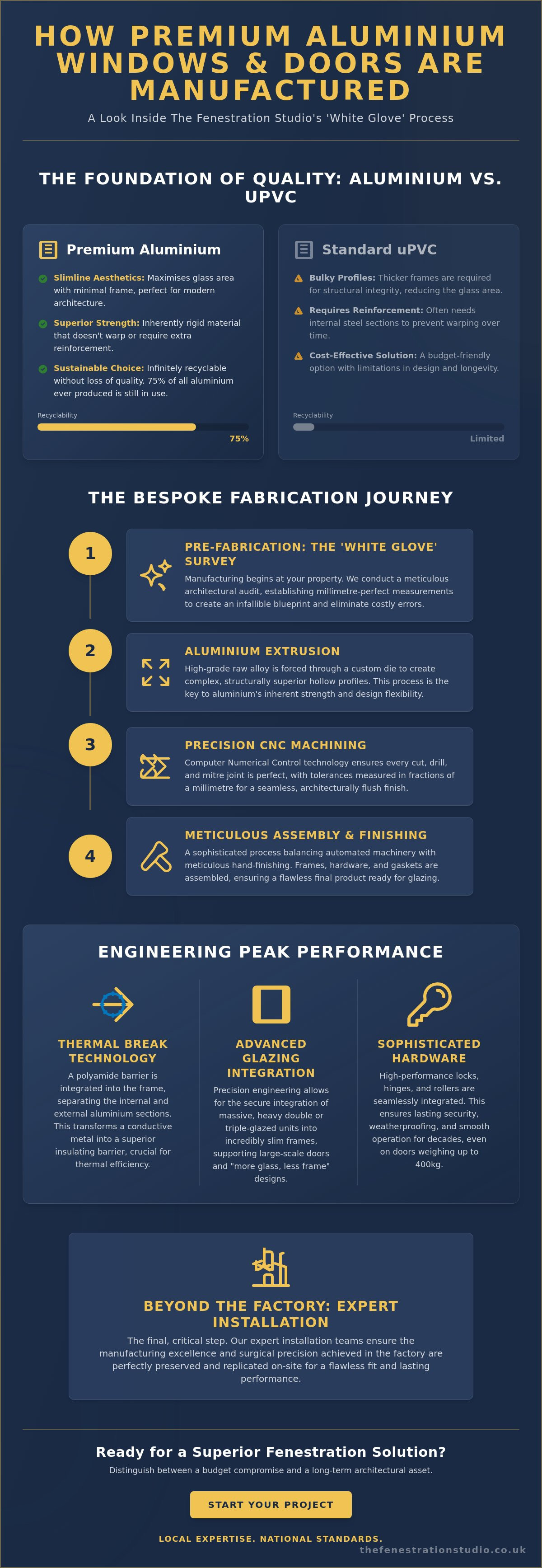
The Aluminium Fabrication Process: From Raw Extrusions to Finished Frames
Understanding how windows and doors are manufactured requires a look at the transition from raw six-metre extrusions to high-performance fenestration. The journey across the factory floor is a calculated symphony of CNC (Computer Numerical Control) automation and artisanal oversight. This isn't a simple assembly line; it's a rigorous engineering process where every frame passes through at least six distinct quality control gates. The goal is to ensure that the final product meets the exact specifications of the architectural survey while maintaining the structural integrity required for decades of use.
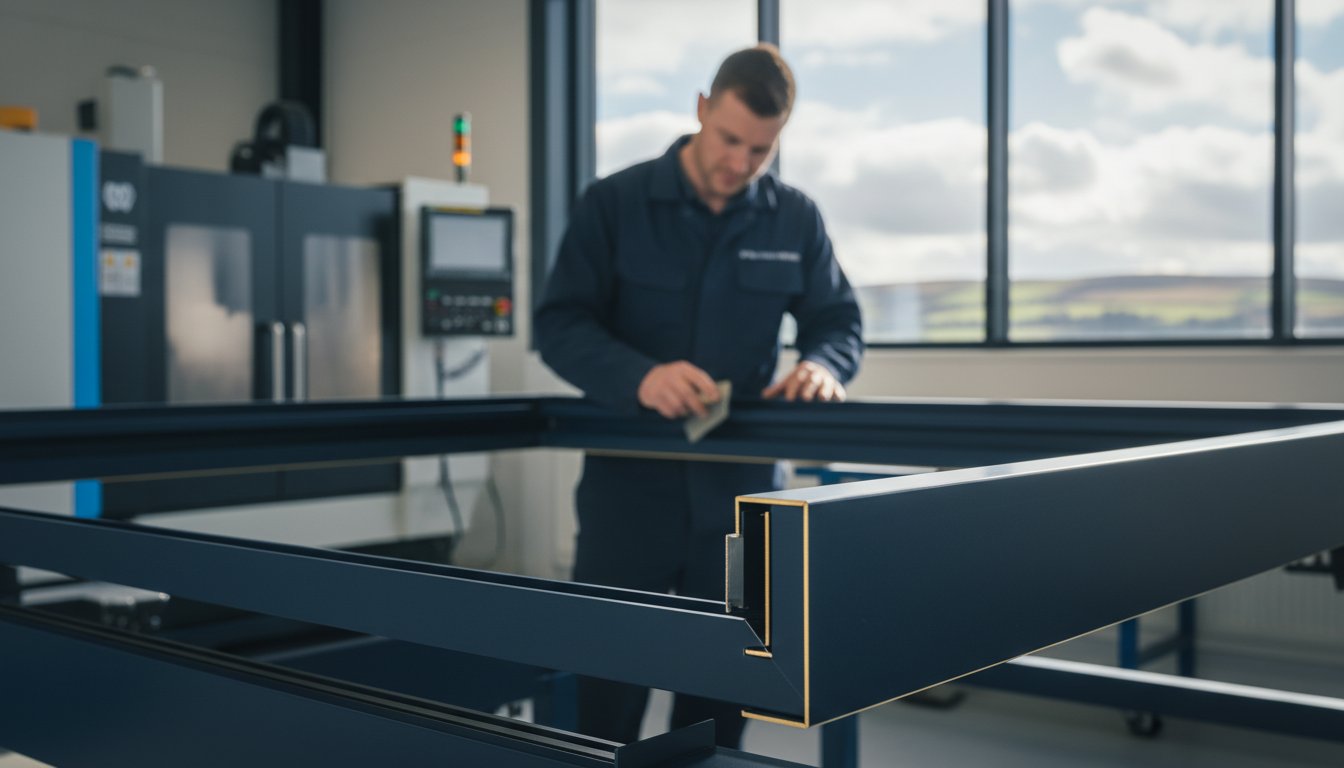
While machines handle the heavy lifting and repetitive precision, skilled technicians provide the hand-finishing that distinguishes premium systems from mass-market alternatives. This balance ensures that whilst the dimensions are mathematically perfect, the tactile elements, such as the smoothness of a mitred corner or the seating of a gasket, receive human validation. Every component is tracked, ensuring that the "White Glove" standard is maintained from the first cut to the final protective wrapping.
Step 1: Precision Cutting and Machining
Precision is the foundation of any high-end installation. Automated double-mitre saws cut the aluminium profiles to exact lengths based on digital survey data, often working to tolerances of less than 0.5mm. Once cut, the profiles move to a machining centre where apertures for locks, handles, and hinges are milled. It's vital that these cuts are "burr-free." Any jagged edges or metal shavings left behind can interfere with the fit of the hardware or compromise the thermal break, leading to expensive mistakes during the installation phase.
Step 2: Coating and Surface Treatment
Durability is dictated by the quality of the surface treatment. Most premium aluminium frames undergo a polyester powder coating process, where the finish is electrostatically applied and cured under heat. This creates a resilient layer typically between 60 and 80 microns thick. For properties located within five kilometres of the British coastline, we specify marine-grade finishes to resist salt-spray corrosion. Many homeowners also opt for dual-colour configurations, a process where the internal and external profiles are coated separately before being joined by a thermal break, allowing for different aesthetics inside and out.
Step 3: Assembly and Jointing
Unlike uPVC, which is heat-welded, aluminium requires sophisticated mechanical jointing. High-tensile corner cleats are inserted into the profiles and secured using hydraulic crimping or heavy-duty screws. We then inject these joints with two-part epoxy resins to ensure they remain rigid and airtight for a 30-year service life. Specific products, such as aluminium sliding doors, demand even more specialized assembly. These systems require the manual integration of heavy-duty stainless steel rollers and bespoke weather-stripping to ensure the "silent glide" that defines the premium experience. This stage is where the Expert Mentor's eye is most critical, checking every seal and fixpoint before the product is cleared for delivery.
Engineering Performance: Thermal Breaks, Glazing, and Hardware Integration
A precision-engineered aluminium frame provides the structural skeleton, but the true performance of a system relies on the components it houses. When considering how windows and doors are manufactured, the integration of thermal and mechanical elements determines whether a product merely fills an opening or actively enhances a building's envelope. A high-end frame is only as effective as the technology sealed within it.
The Science of Thermal Breaks
Aluminium is naturally conductive, which historically led to heat loss and condensation issues. To resolve this, modern manufacturing processes insert a polyamide thermal break between the internal and external aluminium profiles. This high-density, glass-reinforced nylon strip acts as a structural barrier, effectively "breaking" the path of thermal transfer. Whilst older aluminium designs were thermally inefficient, contemporary systems often achieve U-values as low as 0.9 W/m²K. This performance often surpasses traditional timber or uPVC alternatives, directly lowering energy bills and carbon footprints for UK homeowners.
Glazing Technology and Security
The Insulated Glass Unit (IGU) is the functional heart of the fenestration system. During the manufacturing phase, double or triple glazing panes are separated by warm-edge spacer bars and sealed with primary and secondary sealants. This creates a hermetic environment that prevents draughts and internal condensation. Security is a non-negotiable standard. To meet PAS 24:2022 requirements, manufacturers utilise toughened or laminated glass that resists high-impact force. We also ensure that internal glazing beads are used in the assembly. This design choice means the glass cannot be removed from the exterior, providing a vital layer of protection against forced entry.
This emphasis on high-impact resistance and structural safety is a universal standard in glazing; for example, specialists like Auto Glass Force INC. apply these same professional principles to automotive glass repair and replacement to ensure vehicle integrity.
High-Performance Hardware
Hardware must be engineered to withstand the significant weight of large-scale glass panels. For aluminium sliding doors, the use of stainless steel rollers is essential. These components are often tested for 50,000 cycles to ensure the movement remains effortless for decades. Multi-point locking systems are precision-machined into the frame, engaging at several points along the profile to provide maximum structural integrity. Every handle, hinge, and lock is a result of rigorous mechanical testing, ensuring that the final product operates with the same "white glove" precision on day one as it does in year twenty.
Understanding how windows and doors are manufactured allows you to make an informed investment in your home's future. Book a design consultation with our expert team to discuss the technical specifications of your project.
Beyond the Factory: Ensuring Manufacturing Excellence Through Expert Installation
Precision engineering is fragile. Even the most advanced aluminium profile will fail to perform if it's installed incorrectly. The journey of how windows and doors are manufactured culminates in the final millimetre of placement on site. A factory-perfect seal means nothing if the structural opening isn't surveyed with absolute accuracy; a high-performance thermal break is useless if the perimeter isn't correctly insulated. Research within the UK glazing industry suggests that up to 80% of performance complaints originate from installation errors rather than factory defects. This is why The Fenestration Studio manages the entire lifecycle, ensuring that the engineering integrity remains intact from the assembly line to your living room.
Local Expertise. National Standards. This isn't just a tagline; it's a methodology that protects your investment. We treat aftercare as a core part of the manufacturing process. If a door doesn't glide with a single finger's pressure, the engineering hasn't been fully realised. By prioritising an end-to-end service, you eliminate the risk of "finger-pointing" between a separate manufacturer and a third-party fitter. We take total responsibility for the final result.
The Delivery and "White Glove" Handover
Bespoke aluminium products are vulnerable during transit. Surface damage or frame warping often occurs during careless loading. We utilise specialised racking systems to ensure every powder-coated finish arrives in pristine condition. Our local installation teams possess a deep understanding of British building types, from heritage stone cottages to modern steel-frame extensions. Every project concludes with a rigorous on-site inspection. We verify that every lock, hinge, and weather seal operates exactly as it was engineered to do in the factory. This "White Glove" approach ensures your home remains a clean, professional environment throughout the transition.
Avoiding the "Cheap Quote" Trap
The "supply-only" retail market is fraught with hidden costs. While the initial price might look attractive, these quotes often hide shortcuts in hardware quality or inferior thermal breaks. Supply-only sales frequently lead to installation misalignments that void warranties and compromise home security. While the technical specs of how windows and doors are manufactured dictate potential performance, it's the installation that dictates reality. Choosing a manufacturer that cuts corners on the final handover is an expensive mistake that manifests in draughts and condensation within the first 24 months. Don't settle for a product that's only half-finished.
Ready to secure a high-performance solution for your home? Request a professional quote for your bespoke project and experience the difference that expert installation makes.
Secure Technical Excellence for Your Property
Understanding how windows and doors are manufactured is essential for any homeowner prioritising long-term performance over short-term savings. Premium aluminium glazing isn't just about aesthetics; it's a complex assembly where 0.1mm cutting tolerances and polyamide thermal breaks determine your home's thermal efficiency. Industry data indicates that high-quality aluminium frames can maintain structural integrity for over 45 years when engineered correctly, making the fabrication process the most critical factor in your investment. Every component, from the structural extrusions to the integrated hardware, must work in perfect synchronisation to ensure security and weather resistance.
As an independently run family business, we provide a personal touch backed by rigorous technical standards. Our White Glove Service takes you from the initial survey through to dedicated aftercare, removing the stress of project management. Local Expertise. National Standards. We deploy specialised local installation teams across the UK to ensure that the precision engineered in the factory is mirrored in your home. Avoid the expensive mistakes of budget contractors and choose a partner that values architectural integrity.
Book your professional design consultation with our expert team to discuss your project requirements. It's the first step toward a home defined by quality and sophisticated engineering.
Frequently Asked Questions
How long does it take to manufacture bespoke aluminium windows?
Lead times for bespoke aluminium fenestration typically range from 6 to 12 weeks depending on the complexity of your project. Standard RAL colours usually sit at the shorter end of this scale, whilst custom dual-colour specifications require the full 12-week period for precision engineering. This timeline ensures every component meets the BS 6375-1 standard for weather tightness before the product leaves the factory.
Can I choose any colour for my aluminium door frames?
You can choose from over 200 RAL colours to ensure your new doors perfectly complement your property's architecture. Our process allows for dual-colour options, where the internal frame is finished in a neutral tone like White (RAL 9010) and the external face uses a bolder shade like Anthracite Grey (RAL 7016). This level of customisation is a key advantage of how windows and doors are manufactured for the premium market.
What is a thermal break and why is it important in aluminium manufacturing?
A thermal break is a reinforced polyamide strip inserted between the internal and external aluminium profiles to stop heat conduction. Since aluminium is naturally conductive, this barrier is essential to achieve U-values as low as 1.1 W/m²K. It prevents cold bridging, which eliminates internal condensation and keeps your heating bills manageable throughout the British winter.
Are aluminium windows manufactured to standard sizes?
No, premium aluminium windows are manufactured to the exact millimetre of your specific structural opening. We avoid "off-the-shelf" sizes because they often lead to expensive mistakes and poor thermal performance during installation. Every frame is a unique piece of engineering designed to provide a precision fit that standard mass-produced units cannot match.
What is the difference between powder coating and painting?
Powder coating involves applying an electrically charged dry powder to the aluminium and baking it at 200°C to create a resilient finish. This process is far superior to traditional liquid painting because it creates a consistent layer between 60 and 80 microns thick. It's designed to resist chipping and fading for 25 years, even in exposed coastal environments.
How do you ensure the glass in the windows is energy efficient?
We utilise high-performance Low-E glass units that incorporate argon gas-filled cavities and warm-edge spacer bars. This combination reflects heat back into your living space whilst still permitting natural solar gain. Understanding how windows and doors are manufactured with these 28mm or 36mm double-glazed units is the most effective way to reach an A+ energy rating.
Is the manufacturing process different for heritage style windows?
Heritage manufacturing uses specialised "stepped" profiles and ultra-slim sightlines to replicate the look of traditional steel windows. These frames require specific crimping tools and corner bracing to maintain structural integrity despite the narrower aluminium sections. This allows homeowners to maintain a classic aesthetic whilst benefiting from modern 1.5 W/m²K thermal efficiency standards.
Why is a professional survey necessary before manufacturing begins?
A professional survey identifies structural issues like lintel deflection or uneven brickwork that can't be seen by the naked eye. Our surveyors calculate the necessary 10mm expansion gaps and drainage paths required for a flawless installation. This technical assessment prevents the manufacturing of incorrectly sized frames, which is the primary cause of project delays and budget overruns.