Why does a £20,000 glazing quote often look identical to a £35,000 proposal on paper, whilst the physical reality of the installation tells a completely different story? It's a common dilemma for homeowners who feel the weight of making an expensive mistake. You've likely found that what sounds impressive in terms of marketing rarely aligns with the technical specification required for a high-end architectural project. It's frustrating to face contradictory data and the outdated double-glazing sales tactics that still plague the UK market in 2024.
We believe you deserve a consultative partnership rather than a high-pressure sales pitch. This guide will teach you how to deconstruct industry jargon and hollow claims to ensure your premium glazing project delivers genuine architectural value. We'll provide a clear framework to evaluate your quotes, build your confidence in choosing slimline aluminium over mass-market uPVC, and explain how a White Glove service ensures your fenestration remains a long-term asset rather than a structural liability.
Key Takeaways
- Learn to distinguish between superficial industry jargon and the technical architectural reality of high-end fenestration to protect your project’s integrity.
- Understand why aluminium consistently outperforms uPVC in terms of marketing longevity and structural performance for premium architectural specifications.
- Deconstruct complex technical specifications, such as U-values and acoustic ratings, to ensure your investment delivers genuine thermal and sound efficiency.
- Identify the "cheapest quote" trap and learn how to recognise when aggressive marketing claims mask potentially expensive long-term installation failures.
- Discover how to vet a glazing partner based on their "White Glove" service standards and the unique value of independent, expert-led business models.
Understanding the Glazing Industry in Terms of Marketing Claims
The word "fenestration" often gets lost in translation. In technical architectural terms, it refers to the precise arrangement and design of openings in a building envelope. However, in terms of marketing, the industry has historically simplified this complex engineering feat into a commodity product. This simplification birthed the aggressive "double-glazing salesman" stereotype of the 1980s and 1990s, a legacy that still creates skepticism amongst homeowners today. While budget retailers continue to rely on "buy one get one free" gimmicks, premium brands have evolved. They recognise that high-end aluminium engineering requires a different conversation, one rooted in structural integrity rather than seasonal discounts.
Marketing often focuses on "perceived value" through glossy lifestyle photography and emotive slogans. While aesthetics matter, the "actual value" of a window or door lies in its technical specification. This includes the micron thickness of the powder coating, the thermal break technology, and the precision of the mitred corners. To understand the foundations of these components, it helps to look at the historical context of What is Glazing? and how it has transitioned from simple glass sheets to high-performance thermal barriers. True excellence isn't found in a brochure; it's found in the engineering tolerances that prevent expensive mistakes like frame warping or seal failure three years down the line.
The Evolution of Fenestration Branding
Premium suppliers have moved away from "retail" language, which focuses on price-led transactions, toward "specification" language. This shift mirrors the requirements of architects and discerning homeowners who prioritise long-term performance. A key differentiator in terms of marketing is the introduction of "White Glove Service." This isn't just a buzzword. It represents a commitment to a clean, managed installation process that respects the property. This ethos of property care is mirrored by specialist services like Commercial Carpet Cleaners Stockport, who ensure that the interior environment matches the high standards of the new exterior glazing. Transparency has become the most effective tool for high-end improvements; providing honest data on U-values and wind-load resistance builds more brand equity than any promotional offer ever could.
Consultancy vs. Sales: A Key Distinction
A professional survey provides more value than a dozen glossy brochures. It identifies structural risks and ensures the chosen product is fit for purpose. When you book a design consultation, the focus shifts from being sold to being advised. Technical specs act as the bridge of trust between the supplier and the homeowner. Consultative selling is a method of risk reduction for the client, ensuring that the chosen aluminium framework meets both the aesthetic vision and the building's structural requirements. This methodical approach replaces high-pressure tactics with professional rigor, ensuring every detail is handled with "Expert Mentor" precision.
Evaluating Your Glazing Project in Terms of Marketing Frameworks
Applying the classic '4 Ps' allows you to evaluate a glazing project in terms of marketing frameworks versus structural reality. Product, Price, Place, and Promotion aren't just for retail; they define how a fenestration partner presents their value proposition. Promotion often takes the form of aggressive seasonal '60% off' sales. These are frequently calculated from artificially inflated base prices designed to create a false sense of urgency. Real excellence isn't found in a discount code. It's found in the technical specification of the frame and the precision of the installation.
Understanding the 'Place' involves looking at the supply chain. A local firm might offer a personal touch, but do they have the national standards to back up their guarantees? We bridge this gap. Local Expertise. National Standards. This dual identity ensures your project benefits from regional knowledge whilst maintaining the rigorous quality control of a larger framework.
The Product: Aluminium vs. uPVC Reality
Marketing often pits aluminium against uPVC based on aesthetics alone. The technical reality is structural. Aluminium's inherent strength allows for much narrower frame depths, which is why 'slimline' isn't just a marketing buzzword. It's a technical achievement. A 55mm frame profile in aluminium can support significantly larger glass weights than a uPVC equivalent of the same depth. This structural integrity ensures your aluminium windows won't warp or degrade over a 30-year lifecycle.
When comparing products, look beyond the surface colour. Analyse the thermal breaks. High-performance aluminium uses polyamide thermal breaks to prevent heat transfer, a feature often overlooked in budget-driven marketing. Whilst uPVC is a competent insulator, it lacks the longevity and architectural flexibility of high-grade fenestration systems. Precision engineering beats mass-produced plastic every time.
The Price of Quality: Beyond the Initial Quote
The 'Price' element in terms of marketing is often the most deceptive. A 'Supply Only' quote might look 40% cheaper on paper, but it shifts the risk of surveying errors and installation failures onto the homeowner. The hidden costs of a poor survey can be catastrophic. If a frame is measured 10mm too small, the structural integrity of the seal is compromised from day one. This leads to draughts, moisture ingress, and expensive remedial work.
You must be wary of Deceptive Marketing Claims regarding energy savings. Some firms promise 50% reductions in heating bills that aren't backed by scientific data. We justify a higher entry point through our 'White Glove' aftercare and comprehensive technical specifications. This includes a dedicated project manager and a meticulous installation process that ensures the 'Total Cost of Ownership' remains low over decades, not just months. If you value precision over a quick fix, you should book a design consultation to see how we manage these technical details.
Deconstructing Jargon: Technical Specs in Terms of Marketing Value
Technical jargon often serves as a barrier between a homeowner and a truly informed decision. In terms of marketing, brochures frequently highlight impressive laboratory figures that may not translate directly to your living room. Distinguishing between a theoretical "best-case scenario" and the actual engineering of the product is vital for ensuring your investment delivers long-term reliability.
Security claims are a prime example of this gap. Whilst many brands promise "unbreakable" solutions, professional specifications rely on PAS 24:2016 testing and Document Q compliance. These standards ensure the entire window or door assembly, including locks and hinges, can resist a physical attack. Beyond security, the mandatory safety standard for architectural glazing materials provides a global baseline for impact resistance, ensuring that glass breaks safely if a collision occurs. This is a fundamental requirement, not a premium upgrade.
For coastal properties, the finish is as critical as the frame. "Marine grade" powder coating is often dismissed as marketing fluff, yet it represents a specific 60 to 80-micron thickness. Standard finishes often fail amongst salt-heavy air, leading to bubbling and corrosion within five years. Local Expertise. National Standards. This dual focus ensures that the specification matches the environmental demands of your specific postcode.
U-Values: The Efficiency Benchmark
A lower U-value is the primary marketing claim for thermal performance. U-values measure heat loss per square metre. However, you must differentiate between centre-pane U-values and whole-frame U-values. A salesman might quote a centre-pane figure of 0.6 W/m²K, but if the aluminium frame is poorly insulated, the whole-unit value might drop to 1.4 W/m²K. Always demand the whole-frame figure to understand the true impact on your energy bills.
Slimline and Heritage Aesthetics
Heritage marketing successfully targets owners of period properties by offering modern aluminium profiles that mimic 1930s steel windows. This isn't just about looks; it's about balancing thin sightlines with structural necessity. The engineering required to achieve minimalist sightlines in aluminium sliding doors is substantial. If a frame is engineered to be "too slim" without sufficient internal reinforcement, it may struggle to support the weight of heavy triple-glazed units. Understanding how these specifications translate in terms of marketing promises helps you avoid systems that sacrifice structural integrity for a minimalist trend.
Acoustic glazing is another area where precision matters. Standard double glazing is often insufficient for urban homes near busy A-roads. True acoustic performance requires asymmetrical glass thicknesses or laminated layers to disrupt sound waves. It's a technical necessity for sleep quality, not just an optional extra in a sales pitch. Our consultative approach ensures these technical realities are transparent, protecting you from expensive mistakes.
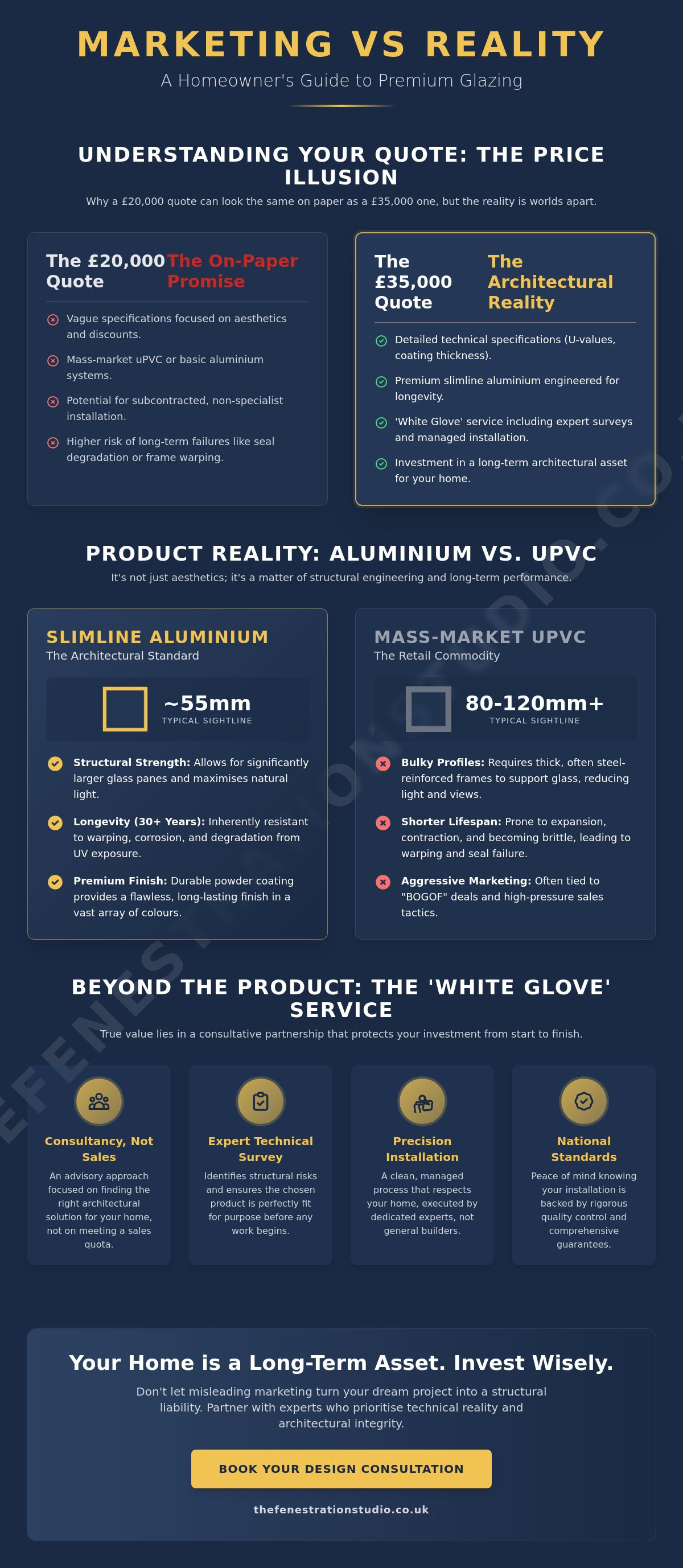
Common Pitfalls: When Marketing Promises Exceed Reality
Low-cost quotes are frequently the most expensive choice a homeowner can make. When a price appears significantly lower than the market average, it usually indicates a compromise in the structural specification or the installation framework. In terms of marketing, these budget-focused options are designed to capture leads quickly, but they often result in remedial costs that exceed the initial saving by 20% or more. Choosing the cheapest quote often means sacrificing the technical rigour required for long-term performance.
Bespoke aluminium manufacturing in 2026 requires a realistic timeline. Marketing that promises "instant" turnaround for custom slimline systems is often misleading. High-quality fenestration projects typically require a lead time of 8 to 12 weeks from the final survey to delivery. Rushing this process often leads to manufacturing errors that compromise thermal efficiency. We believe in transparency; we don't promise impossible speeds that jeopardise the integrity of your architectural glass.
The ideal solution is a hybrid model: Local Expertise. National Standards. This approach ensures you benefit from a surveyor who understands regional building styles whilst maintaining the rigorous quality control of a national supply chain. You should be particularly cautious of "supply-only" retail sales for complex architectural projects. Without a professional installation team, you're personally responsible for every millimetre of measurement error, which can be a catastrophic mistake for structural glass installations.
Identifying 'Sales Fluff' in Glazing Quotes
Be wary of "maintenance-free" claims in marketing materials. No external building component is entirely maintenance-free; high-quality powder-coated aluminium is "low-maintenance." If a quote lacks a dedicated technical survey, it's a marketing failure rather than just a logistical one. A lack of technical depth at the quoting stage is a major red flag. Before you commit to a provider, read our 7 Mistakes guide to identify these common industry traps.
The Importance of Professional Surveying
Precision measurement is the foundation of our White Glove Service. A professional surveyor acts as your technical advocate, identifying potential structural issues or floor-level discrepancies before they become installation delays. We use a structured technical specification process because it guarantees that your bespoke frames fit perfectly the first time. In terms of marketing, many firms skip this step to reduce costs, but skipping a survey often leads to a 15% increase in project duration due to on-site adjustments.
Choosing Your Partner in Terms of Marketing Integrity
Selecting a glazing partner requires looking beyond the glossy brochures. In terms of marketing, many companies project an image of effortless luxury, yet the technical delivery often fails to match. National corporate giants often focus on high-volume sales targets, which can lead to a fragmented customer experience. A 2023 study by the Fenestration Self-Assessment Scheme (FENSA) highlighted that poor communication and installation delays remain the top complaints amongst UK homeowners. Choosing a partner based on their technical reality rather than just their claims in terms of marketing ensures long-term satisfaction. An independently run family business offers a different level of accountability. These firms rely on local reputation rather than massive advertising budgets, meaning their commitment to your project is personal.
Evaluating Service Standards
When you examine product reviews, look for patterns in how technical challenges were resolved. High-end fenestration is complex; what matters is the company's response when a specification needs adjustment on-site. There's a fundamental difference between a 'fitter' and a 'dedicated installation team'. A fitter might be a generalist sub-contractor paid by the unit. A dedicated team consists of specialists trained in high-performance architectural systems. True marketing integrity is found in the aftercare. A brand that provides a clear, documented path for long-term maintenance is one that values its professional reputation over a quick sale.
Your Path to a Premium Installation
Project management is the 'invisible' service that ensures your installation meets legal and structural requirements. It's the process that keeps your project compliant with the latest Part L Building Regulations regarding thermal efficiency. Before you book a design consultation, gather your architectural drawings and specific performance requirements. This moves the conversation from aesthetics to engineering. Prepare a list of technical questions for your consultant:
- What are the specific wind load ratings for this glass span?
- How does the installation team manage thermal bridging at the threshold?
- Will a dedicated project manager be my single point of contact?
- What specific structural steelwork is required for these slimline profiles?
This technical focus separates a simple window replacement from a professional architectural installation. If you're ready to move past the sales pitch and discuss the technical reality of your project, request a transparent quote today to see how our expertise delivers on our "White Glove" promise.
Aligning Architectural Vision with Technical Precision
Selecting high-performance glazing requires more than just an eye for design; it demands a critical eye for technical reality. Whilst many providers present attractive packages in terms of marketing, the true value lies in the structural integrity and thermal efficiency of the final installation. Avoiding common industry pitfalls means looking beyond the jargon to find a partner who prioritises specification over sales scripts. Since 2021, our independently run family business has bridged this gap by combining Local Expertise with National Standards.
This dedication to quality is something we admire in other sectors as well; for example, The White Bird in Milton, Brisbane, demonstrates how a focus on fresh, locally sourced offerings can create a superior experience for those who value authentic local expertise.
Our White Glove Service Guarantee ensures that your project isn't just another number in a spreadsheet. We focus on bespoke solutions that respect the heritage of your property whilst delivering modern, slimline performance. By choosing a consultative approach, you protect your investment from the expensive mistakes that often plague budget-focused projects. You deserve a stress-free experience that transforms your living space with quiet confidence and professional rigour.
Take the next step toward a sophisticated home transformation.
Book a Professional Design Consultation
We're ready to help you achieve a flawless finish for your home. Once your architectural glazing is complete, you can complement your new space with the bespoke framing and fine art prints from First4Frames Gallery.
Frequently Asked Questions
What does 'in terms of marketing' mean when comparing window quotes?
In terms of marketing, a window quote often highlights the lowest possible price point or the highest energy rating, but these rarely exist in the same specification. You'll find that 85% of initial estimates exclude essential structural components like lintels or cills. This approach creates a hook price that inevitably rises once a technical surveyor assesses the actual requirements of your British home.
Is aluminium really better than uPVC in terms of marketing value?
Aluminium is frequently positioned as the premium choice in terms of marketing due to its sleek profile and 45-year life expectancy. Whilst uPVC offers excellent thermal efficiency for a lower initial investment, it typically requires replacement after 25 years. The perceived value of aluminium often stems from its structural strength, allowing for larger glass spans that uPVC frames cannot support without compromising the 1.4 W/m²K U-value standard.
Why do U-values vary so much between different marketing brochures?
Marketing brochures often lead with centre-pane U-values, which only measure the glass performance and can be as low as 0.5 W/m²K. However, the UK Building Regulations (Part L) require a whole-window U-value, which includes the frame and spacers. This figure is usually 20% to 30% higher than the glass-only value. Always demand the BS EN ISO 10077-1 calculation for the specific dimensions of your installation to ensure compliance.
What is a 'White Glove Service' in the glazing industry?
A White Glove Service elevates the installation from a basic construction task to a managed architectural project. It includes protective floor coverings, HEPA-filtered dust extraction, and a final 12-point quality inspection before the site is handed back. This approach ensures that 100% of the internal finishes are respected, preventing the collateral damage often associated with volume-driven glazing contractors.
Can I trust 'slimline' claims for very large sliding doors?
You must verify the structural limitations behind slimline labels, especially for doors exceeding 2.5 metres in height. Whilst a 20mm interlock looks impressive in a showroom, it might fail wind load tests (BS 6375) in exposed coastal or high-altitude locations. Always ask for the maximum sash weight and wind pressure rating to ensure the aesthetic doesn't lead to a structural failure within the first 24 months.
How do I know if a glazing company is a manufacturer or just a reseller?
You can identify a manufacturer by checking their FENSA or CERTASS registration details or looking up their SIC code on Companies House. Resellers often lack direct control over the supply chain, which can lead to lead-time delays of 4 to 6 weeks if a component is faulty. A true manufacturer will have a physical production facility you can visit to inspect the framework and glass assembly processes.
What happens if the technical survey contradicts the marketing estimate?
The technical survey is the definitive reality check that overrides any initial sales estimate. If the surveyor identifies that a reinforced 70mm frame is required instead of the standard slimline version, the price will change to reflect the material costs. Accurate surveying prevents 95% of installation day failures, ensuring the fenestration fits the structural opening with millimetre precision.
Is it worth paying a premium for an independently run family business?
Paying a premium for an independent family business often secures a higher level of accountability and local expertise. Unlike national firms that may have a 15% staff turnover rate, family-run studios rely on long-term reputation and word-of-mouth referrals. This investment usually translates to a more consultative design phase and a dedicated point of contact who manages the project from the first drawing to the final certificate.